
The foundation of any successful training program lies in a thorough needs analysis.
Understanding Needs Analysis
What is Needs Analysis?
Needs analysis in the context of training development is a systematic process of identifying and addressing gaps between current conditions and desired outcomes. It involves:
- Listening closely to client requirements
- Understanding the target audience
- Analyzing existing data
- Identifying knowledge or skill gaps
- Determining the most effective training approaches
The Significance of Needs Analysis
A well-executed needs analysis:
- Ensures training aligns with organizational goals
- Maximizes the return on investment (ROI) of training programs
- Increases the relevance and effectiveness of learning experiences
- Helps in prioritizing training needs
- Provides a foundation for measurable outcomes
The Art of Listening: Client and Audience Understanding
Active Listening with Clients
One of the most crucial aspects of needs analysis is active listening. When engaging with clients:
- Encourage open dialogue to uncover underlying issues
- Ask probing questions to clarify ambiguities
- Validate your understanding by summarizing key points
- Be receptive to feedback and additional information
Empathizing with the Audience
To create truly impactful learning experiences, we must go beyond demographics and dive deep into the psychographics of our learners. This involves:
- Considering the learners’ background, experiences, and motivations
- Understanding their challenges and pain points
- Identifying their preferred learning styles and environments

Data-Driven Insights: Combining Empathy with Analytics
While empathy provides qualitative insights, combining it with quantitative data creates a more comprehensive picture. This may include:
- Performance metrics
- Skill assessments
- Engagement statistics from previous training programs
- Feedback from past participants
By marrying empathetic understanding with hard data, we can create a more nuanced and accurate representation of our target audience.
User Personas: A Borrowed Practice from UX Design
The Power of User Personas
In my practice, I’ve found great value in borrowing the concept of user personas from user experience (UX) design. User personas are fictional characters created to represent different user types within a targeted demographic, attitude and/or behavior set that might use a site, brand or product in a similar way.
Creating Effective User Personas
When creating user personas for learning design:
- Focus on behavioral patterns rather than demographic details
- Use data to inform persona creation
- Include goals, motivations, and pain points
- Avoid stereotypes and oversimplification
As Amber Westerholm-Smyth astutely points out:
We want you to:
– Focus on your users as people, not what defines them in a census.
– Allow the depth of data and richness of insights to flourish. Humans are complex.
– Stop letting people judge your personas by their cover, strip out looks and personification.
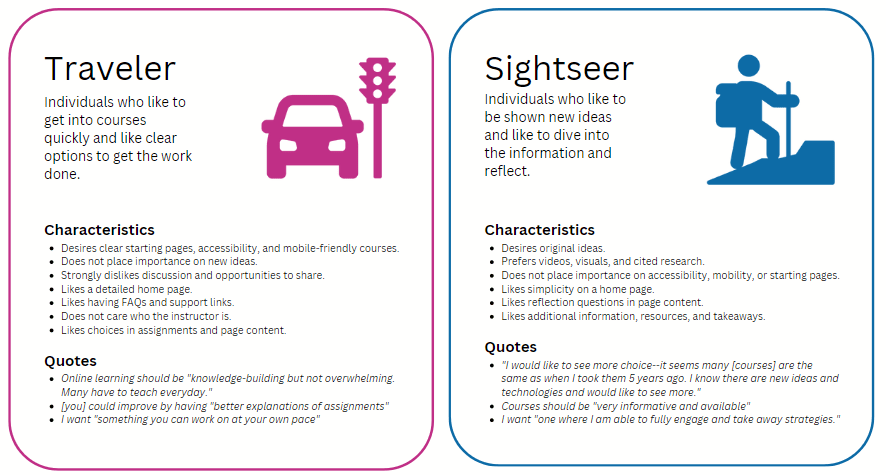
Using Metaphors and Symbols
To avoid stereotyping and to create more universally applicable personas:
- Use metaphors to represent different learner types (e.g., “The Explorer” for a self-motivated learner)
- Employ symbols to represent key characteristics or behaviors
- Focus on motivations, goals, and challenges rather than age or appearance
Challenges in Needs Analysis
While needs analysis is crucial, it’s not without its challenges:
- Time constraints often pressure us to skip or rush this vital step
- Stakeholders may have preconceived notions about what training is needed
- Gathering accurate data can be difficult, especially in large organizations
- Balancing diverse needs within a single training program
Key Takeaways
- Needs analysis is the cornerstone of effective training development
- Active listening and empathy are essential skills for learning specialists
- Combine qualitative insights with quantitative data for a comprehensive understanding
- User personas, when created thoughtfully, can be powerful tools in learning design
- Focus on behaviors, motivations, and goals rather than demographics
- Challenges in needs analysis should be anticipated and addressed proactively
Conclusion
In the evolving landscape of learning and development, needs analysis remains a critical component of creating impactful training experiences. By taking the time to listen, empathize, and analyze, we can design learning experiences that not only meet the immediate needs of our clients but also resonate deeply with our learners.
 Brady Licht