
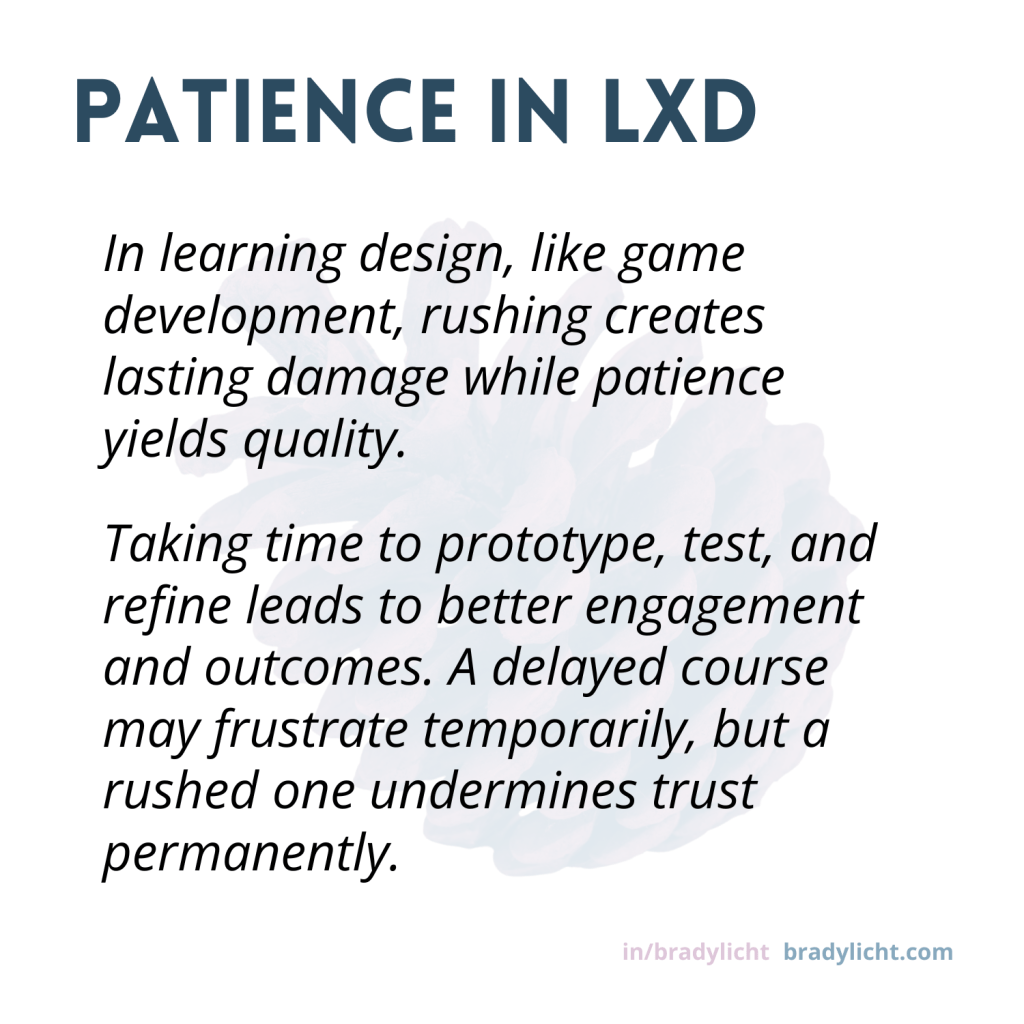
In the world of video game development, Shigeru Miyamoto’s (misattributed) quote, “A delayed game will eventually be good, but a rushed game is forever bad,” has become a guiding principle for many developers. But what if we applied this wisdom to the field of learning experience design? As an instructional designer with years of experience, I’ve come to realize that this principle holds just as true in our field.
The Temptation of Speed vs. The Value of Patience
The Rush to Release
In the fast-paced world of corporate training and e-learning, there’s often immense pressure to deliver learning solutions quickly. Stakeholders want results, learners need skills, and we, as designers, feel the weight of these expectations. I’ve been there – the temptation to rush a course or training program out the door can be overwhelming.
However, just as a rushed video game can tarnish a developer’s reputation, a hastily designed learning experience can have long-lasting negative impacts:
- Learner disengagement
- Ineffective knowledge transfer
- Reinforcement of the notion that training is a waste of time
- Damage to the credibility of the L&D department
The Power of Patience
On the flip side, taking the time to develop a well-crafted learning experience can yield significant benefits:
- Higher learner engagement
- Improved knowledge retention and application
- Enhanced reputation for the L&D team
- Better alignment with organizational goals
I’ve learned that when I invest time in the design process, the resulting learning experiences are not just good – they’re transformative.
Prototyping and Testing: The Keys to Success
Moving Beyond the Waterfall
Traditionally, many instructional designers have relied on the ADDIE model (Analysis, Design, Development, Implementation, Evaluation) – a waterfall approach that can lead to lengthy development cycles and missed opportunities for improvement. While ADDIE has its place, I’ve found that incorporating agile methodologies and rapid prototyping can dramatically improve the quality of the final product. For those struggling to adopt more agile methods, I’ve found that the Spiral Model articulated by Cennamo and Kalk in Real World Instructional Design is a great balanced approach.
The Power of Prototyping
Prototyping is a crucial component of agile and balanced approaches. Here’s how I integrate prototyping into my design process:
- Create low-fidelity mockups: Use tools like paper prototypes or simple wireframes to visualize initial concepts.
- Develop interactive prototypes: Utilize rapid e-learning tools to create clickable prototypes that simulate the learning experience.
- Conduct user testing: Gather feedback from a sample of learners to identify areas for improvement.
- Iterate and refine: Use the feedback to make improvements before moving to full development.
By prototyping and testing early and often, we can ensure that the final learning experience will meet learner needs and organizational objectives.
The Importance of First Impressions in Learning Design
Overcoming Negative Perceptions
Let’s face it – training often has a bad reputation. Many learners approach new courses or programs with skepticism, expecting boring content or irrelevant information. This is why first impressions are crucial in learning experience design.
Crafting a Positive First Impression
To create a positive first impression, consider the following:
- Engaging opening activities: Start with something that immediately captures learner attention and demonstrates value.
- Clear learning objectives: Communicate the relevance and benefits of the training upfront.
- Polished user interface: Ensure that the learning management system (LMS) or e-learning platform is intuitive and visually appealing.
- Personalized learning paths: Use adaptive learning technologies to tailor the experience to individual learner needs.
I once worked on a compliance training program that had a reputation for being dry and tedious. By taking the time to redesign the opening module with interactive scenarios and clear value propositions, we saw a significant increase in learner engagement and completion rates.
The Long-Term Benefits of Delayed Release
Quality Over Speed
While it can be tempting to launch a learning solution quickly to meet immediate needs, the long-term benefits of a delayed but polished release often outweigh the short-term gains of a rushed product.
Benefits of a Well-Crafted Learning Experience
Taking the time to perfect a learning experience can lead to:
- Higher learner satisfaction: Learners appreciate well-designed, engaging content.
- Improved learning outcomes: Better design often leads to better retention and application of knowledge.
- Reduced need for revisions: A polished product requires fewer updates and fixes post-launch.
- Enhanced reputation: High-quality learning experiences build trust in the L&D function.
I’ve seen firsthand how a delayed but well-executed blended learning program can become a flagship offering, setting the standard for future training initiatives.
Embracing the Miyamoto Principle
As learning experience designers, we have the power to shape how people acquire new knowledge and skills. By embracing Miyamoto’s principle and prioritizing quality over speed, we can create learning experiences that not only meet immediate needs but also stand the test of time.
Let’s commit to:
- Resisting the urge to rush our designs
- Embracing agile methodologies and rapid prototyping
- Focusing on creating strong first impressions
- Prioritizing long-term impact over short-term gains
Remember, in learning experience design, as in game development, patience truly does pay off. A delayed learning experience may cause temporary frustration, but a rushed one can damage learner trust and organizational effectiveness for years to come. Let’s take the time to get it right – our learners deserve nothing less.
 Brady Licht