
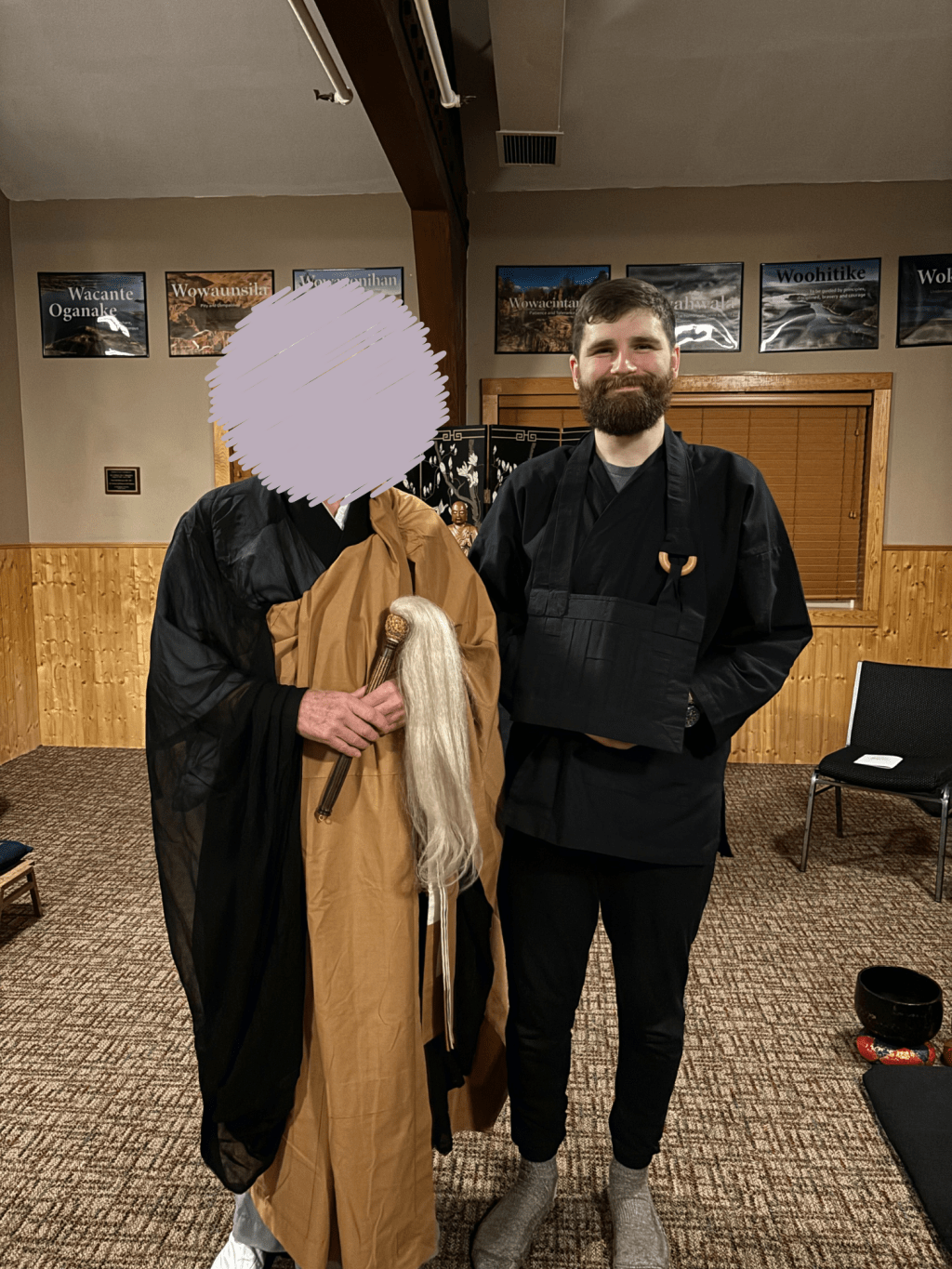
As an e-learning consultant and a student of Zen, I spend a lot of my professional life trying to make learning more efficient and a lot of my personal life sitting with a practice that refuses to be efficient at all. These two parts of my world do not always agree with each other, and I have been thinking about that friction more than usual lately.
This is not an article where I tie the two together into a neat framework. It is more of an honest look at what happens when the principles I rely on professionally bump up against what I am learning in a very different kind of education.
The Efficiency Impulse
In e-learning, efficiency is one of the first things we reach for. We break down complex topics into digestible modules. We create bite-sized microlearning experiences. We streamline content for quick consumption and optimize for completion rates. There are good reasons for all of this, especially when the goal is broad access to information in contexts where people have limited time and bandwidth.
I believe in that work. I have built my career around making digital learning more accessible and more effective, and I have seen what well-designed, efficient learning experiences can do for people who would otherwise not have access to the content at all. In rural and remote settings, where I do most of my work, efficiency is not a luxury; it is often the difference between something existing and nothing existing.
At the same time, my Zen practice keeps surfacing a question I cannot quite resolve: what happens to the kinds of learning that cannot be made efficient?
What Koan Study Actually Looks Like
A significant part of my Zen training involves working with koans in dokusan, which are private, one-on-one interviews with a teacher. For those unfamiliar, koans are brief stories, dialogues, or questions from the Zen tradition that point toward the nature of reality beyond conceptual thinking. They are not riddles to be solved. They are more like lenses that change how you see.
My experience with koan study in a Western Zen center has challenged several assumptions I carry from my professional life, and I want to walk through a few of them honestly rather than turning them into design principles.
The intimacy of one-on-one learning. In traditional koan practice, students work privately with a teacher in short, intense meetings where the student presents their understanding. The teacher responds to exactly where each student is. There is no hiding behind written responses or carefully worded answers. The relationship between teacher and student deepens over months and years, and that depth is not incidental to the learning; it is the condition that makes certain breakthroughs possible. The most transformative moments I have experienced in this practice emerged from the specific chemistry between me and my teacher, in ways that could not have been replicated through any other delivery method.
This is hard to sit with professionally, because so much of what I do is about scale. I help build systems that reach hundreds of educators across a state. The whole premise is that good design can extend learning beyond the one-on-one encounter. And it can. But koan practice keeps reminding me that some kinds of understanding only emerge in direct, personal contact, and that no amount of clever design makes up for the absence of a real human relationship.
Learning through repeated failure. Unlike most educational models that aim for steady, measurable progress, koan study involves repeated encounters with the same material over weeks, months, or sometimes years. Students present their understanding, get turned away, return with fresh perspectives after more practice, and experience breakthrough moments that cannot be predicted or scheduled. In some ways, it is the study of one key insight that gets refracted through many different iterations.
In my professional world, we design for progress. We build learning paths with clear milestones and celebrate completion. Koan practice has no completion rate. The learning happens in the repeated returning, not in linear advancement through content. Some forms of mastery require a tolerance for sustained confusion and apparent failure, and that is almost the opposite of what we optimize for in e-learning.
I do not have a clean way to reconcile these two things. I still believe in well-structured learning progressions. I also know from direct experience that some of the most important shifts in my own understanding came after long stretches of feeling completely stuck.
Embodied understanding versus intellectual knowledge. Contemporary koan practice emphasizes that intellectual analysis, while valuable, is not the goal. Students learn to express understanding through presence and spontaneous response rather than explanation, to embody insights in daily life and sitting practice, and to recognize the difference between knowing about something and actually realizing it. Not all learning is informational. Some knowledge is transformational, and it has to be lived into rather than transmitted through content.
This distinction haunts me a little in my design work. Most of what I build is, by necessity, informational. I am helping people acquire knowledge and skills they can apply in their roles. That is valuable, and I do not want to diminish it. But koan practice has made me more aware of the moments when I am designing for information transfer and quietly hoping it will produce transformation. Those are different things, and being honest about which one I am actually doing matters.
Community context and shared practice. One thing that surprised me about koan work is how much the private, individual practice depends on a broader community of practitioners. The breakthroughs happen in dokusan, but they are supported by the rhythms of group sitting, shared meals, and the simple presence of other people engaged in the same difficult work. Individual learning thrives within a committed community of practice, even when the actual learning moments are private and non-transferable.
This one translates more naturally to my professional world. I have seen how online courses come alive when learners feel connected to others doing similar work, even when the course itself is self-paced. Community does not replace the learning; it creates the conditions for it. That is something both traditions seem to agree on.
The Tension I Am Sitting With
Koan practice has taught me that some of the most valuable learning, the kind that actually changes how you see and respond to the world, cannot be packaged into modules or delivered through content. It emerges through sustained engagement, personal relationship, and the willingness to not know.
This does not mean e-learning is inadequate. It means I need to be more honest about what it can and cannot do. There are learning objectives that benefit enormously from efficient, well-designed digital delivery, and there are others that require something slower, more relational, and harder to measure. The challenge I keep coming back to is discernment: knowing which is which, and designing accordingly rather than defaulting to the approach I know best.
I do not have that fully figured out yet. What I have is the tension itself, and a growing suspicion that sitting with it honestly is more productive than resolving it prematurely.
If any of this resonates with your own experience, whether you come at it from a contemplative practice, a design background, or somewhere else entirely, I would be glad to hear from you. You can reach me at licht.education@gmail.com, and you can find more of my writing at bradylicht.com.
 Brady Licht