
“All that you touch You Change. All that you Change Changes you. The only lasting truth Is Change.” — Octavia Butler
When One-Size-Fits-All Training Doesn’t Fit Anyone
You’ve been there: implementing a “proven” training program only to watch it struggle in your unique context. The rural community center with spotty WiFi. The small organization with no budget for fancy platforms. The team that learns differently than the original audience.
What if learning design could grow as naturally as a garden?
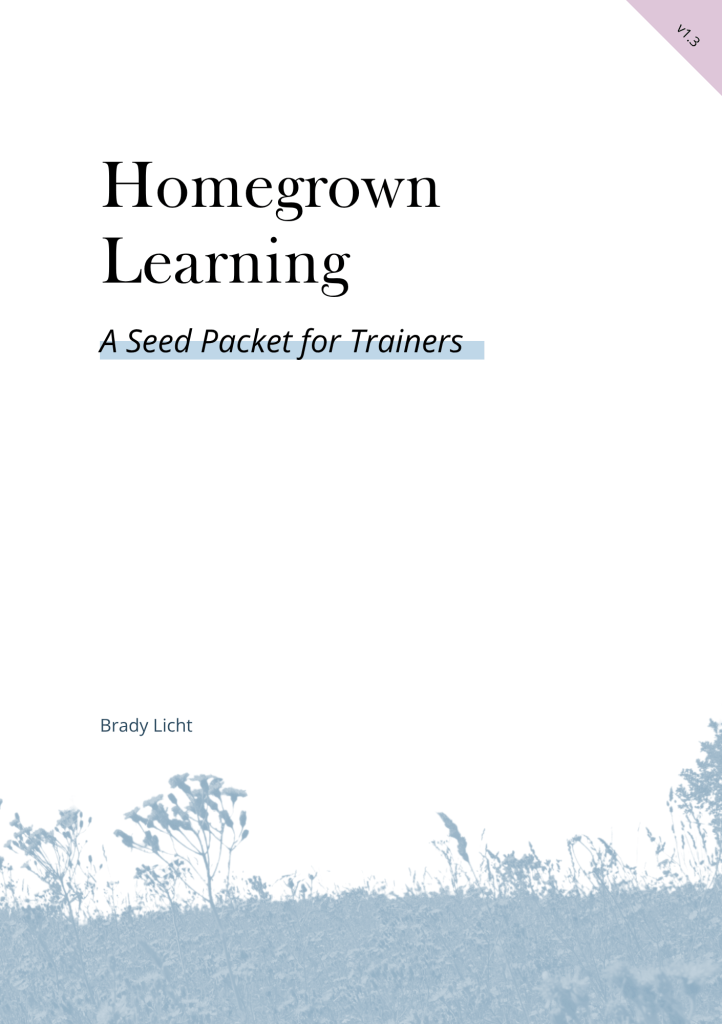
Homegrown Learning is a field guide for creating learning experiences that fit the communities they serve. Instead of transplanting generic solutions and hoping they take, this workbook helps you design from the ground up, working with the resources, relationships, and knowledge that already exist in your context.
Why This Book Exists
After years of designing training programs across the Great Plains, I kept running into challenges that standard instructional design texts rarely address. Most assume ideal conditions: reliable technology, adequate budgets, audiences that match the ones the original program was built for. The reality, especially in rural and resource-constrained settings, is usually different.
This book is built around that reality. It focuses on context-sensitive design that works with available resources rather than against them, on sustainability beyond the initial launch through community ownership and natural systems thinking, and on low-tech alternatives for situations where high-tech isn’t accessible or appropriate. It also takes seriously the idea that community voices should shape the design from the beginning, not get consulted at the end.
How This Book Is Different
Homegrown Learning follows the Spiral Model of instructional design (Define, Design, Demonstrate, Develop, Deliver) by Cennamo and Kalk, but it integrates perspectives you won’t find in most ID texts: life-centered design, biomimicry, calm design, and sustainable systems thinking.
The structure models the approach it teaches. You can read it sequentially as you develop a specific project, or jump to the sections that are most relevant to where you are in the process. Each of the five phases contains three types of pages: INFO pages that share ideas and perspectives, TOUCHSTONE pages that offer space for reflection, and FIELDWORK pages that invite you to explore and create.
The five phases are:
- DEFINE — Understanding your learning ecosystem through patient observation
- DESIGN — Cultivating solutions that honor community context
- DEMONSTRATE — Testing through low-risk prototyping
- DEVELOP — Planting and pruning with sustainable resources
- DELIVER — Sharing the harvest and planning for long-term success
Who It’s For
This book is primarily for learning designers and trainers working in rural or resource-limited contexts, educators designing culturally responsive programs, and anyone who believes learning solutions should work with communities rather than be imposed on them. If you’ve ever felt like the standard approaches assume conditions you don’t have, this was written with you in mind.
Current Status
Homegrown Learning is in continuous development, with ongoing revisions based on feedback from learning designers, educators, and communities. The current digital draft is available for free for those who want to read it as it evolves.
For those who prefer a physical copy, a print-on-demand version is available through Amazon. Keep in mind that the print version may not reflect the most recent revisions.
Get in Touch
Whether you’re designing professional development for rural teachers, training programs for community organizations, or learning experiences for teams with limited resources, I’d like to hear how you’re applying these ideas. Share insights, ask questions, or just say hello through the form below.
Homegrown Learning: A Seed Packet for Trainers is licensed under a Creative Commons Attribution-NonCommercial-ShareAlike 4.0 International License.
 Brady Licht