

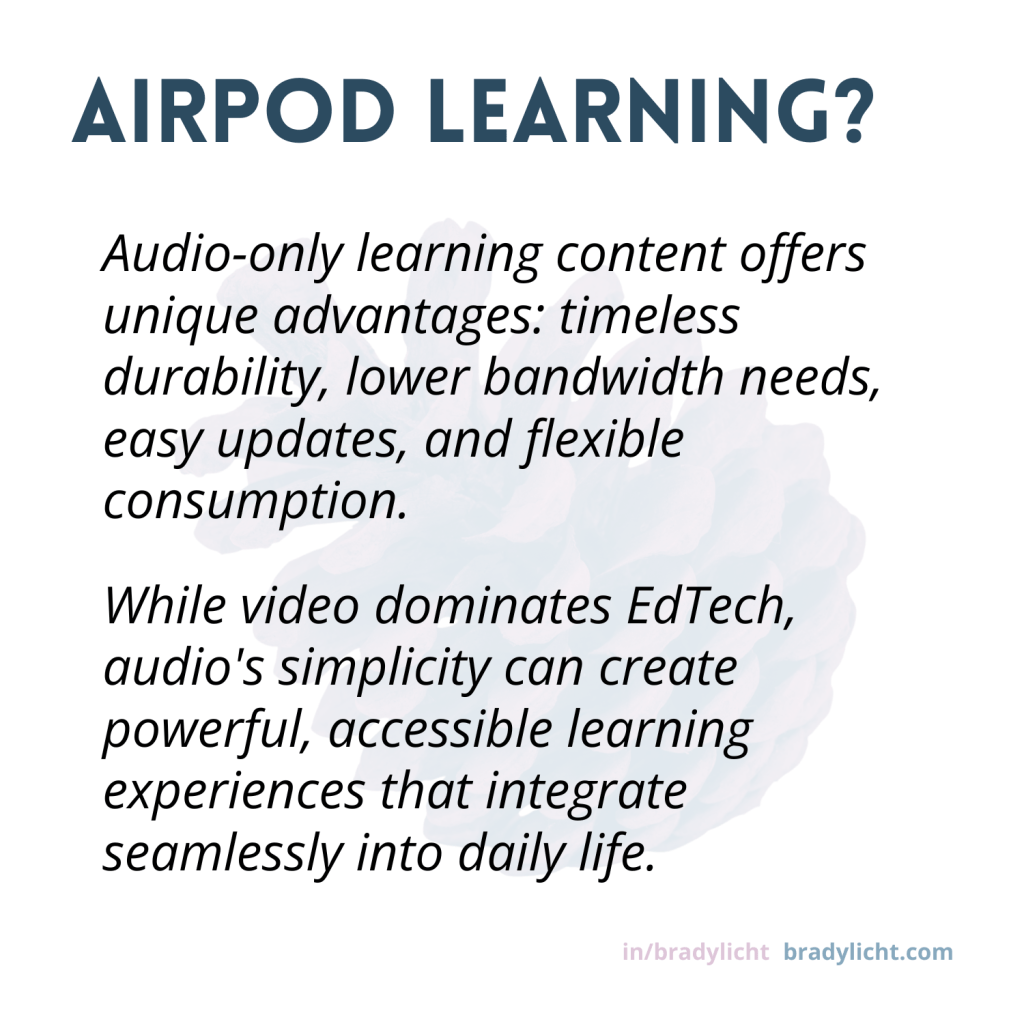
In the realm of instructional design and learning experience creation, the adage “less is more” can often ring true. While multimodal learning has been the focus of much research and implementation, there’s a compelling case to be made for audio-only content in certain educational contexts.
As someone deeply involved in instructional design and learning experience design work, I’ve observed firsthand the power of simplicity in educational content. This philosophy is beautifully captured by Koichi Kawana’s words:
“Simplicity means the achievement of maximum effect with minimum means.”
This principle, when applied to instructional design, leads us to consider the effectiveness of audio-only content in achieving learning objectives.
The Advantages of Audio-Only Content
1. Longevity and Timelessness
One of the primary benefits of audio-only content is its ability to remain relevant for extended periods. Unlike videos, which can quickly become dated due to:
- Changing fashion trends
- Evolving technology (e.g., outdated computer interfaces)
- Improving video quality standards
Audio content focuses solely on the message, allowing it to age more gracefully and remain useful for longer periods.
2. Alignment with Calm Technology Principles
Audio-only content adheres more closely to the principles of Calm Technology, which aims to reduce unnecessary cognitive load and technological intrusion. Benefits include:
- Lower bandwidth requirements
- Reduced data consumption
- Improved accessibility for users with limited internet access
These factors are particularly crucial for:
- Learners in rural areas
- Students in developing regions
- Those relying on mobile data plans
3. Maintaining Instructor Presence
While video is often touted as the best medium for creating instructor presence, audio can still effectively:
- Convey the instructor’s personality
- Create a sense of connection
- Provide a human touch to the learning experience
In my learning experience design work, I’ve found that learners often report feeling a strong connection to instructors through audio content, particularly when it’s well-produced and engaging.
4. Enhanced Mobility and Flexibility
Audio-only content excels in providing flexibility for adult learners. It allows for:
- Multitasking during household chores
- Learning while commuting
- Engagement during exercise or other activities
This flexibility is often underestimated by instructors who may overvalue the visual component of their content.
5. Reduced Production Time and Resources
A major benefit of audio-only content that shouldn’t be overlooked is the significantly reduced production time compared to video content. This advantage has implications both in the initial creation and in maintenance. When content needs to be updated or corrected, making changes to audio is generally simpler and less time-consuming than re-shooting video content.
In my experience as a learning experience designer, this reduction in production time and resources can be a game-changer, especially for projects with tight deadlines or limited budgets. It allows for more experimentation and iteration in content creation, potentially leading to more effective learning materials.
Implementing Audio-Only Solutions
Micropodcasts
Micropodcasts are short, focused audio segments that can be easily consumed. They’re ideal for:
- Introducing key concepts
- Summarizing important points
- Providing quick tips or insights
Recorded Interviews
Interviews with subject matter experts can:
- Bring diverse perspectives to the learning experience
- Provide real-world context
- Enhance engagement through conversational formats
Audio Scenarios
Audio scenarios can be powerful tools for:
- Problem-solving exercises
- Decision-making simulations
- Soft skills training
All three of these can be produced quick
Challenges and Considerations
While audio-only content offers numerous benefits, it’s important to consider potential challenges:
- Content suitability: Not all topics are equally suited to audio-only formats. Visual subjects may require alternative approaches.
- Accessibility concerns: Ensure proper transcripts and closed captions are available for hearing-impaired learners.
- Production quality: High-quality audio recording and editing are crucial for maintaining engagement.
Reflection and Future Directions
As a learning experience designer, I’ve observed a tendency in our field to default to video content, often without critically examining its necessity. Moving forward, I believe we should:
- Carefully evaluate the need for visual elements in each learning module
- Consider the long-term maintenance and updating requirements of our content
- Prioritize accessibility and flexibility for diverse learner populations
“The most profound technologies are those that disappear. They weave themselves into the fabric of everyday life until they are indistinguishable from it.” – Mark Weiser
This quote from the father of ubiquitous computing encapsulates the potential of audio-only instructional content. By seamlessly integrating into learners’ lives, audio can provide powerful educational experiences without the overhead and limitations often associated with video.
Conclusion
While video certainly has its place in instructional design, the benefits of audio-only content should not be overlooked. By embracing simplicity, enhancing accessibility, and focusing on the core message, audio-only solutions can provide effective, long-lasting, and flexible learning experiences. As we continue to evolve our instructional design and learning experience creation practices, let’s not forget the power of the spoken word and the unique advantages it can bring to the learning process.
 Brady Licht