
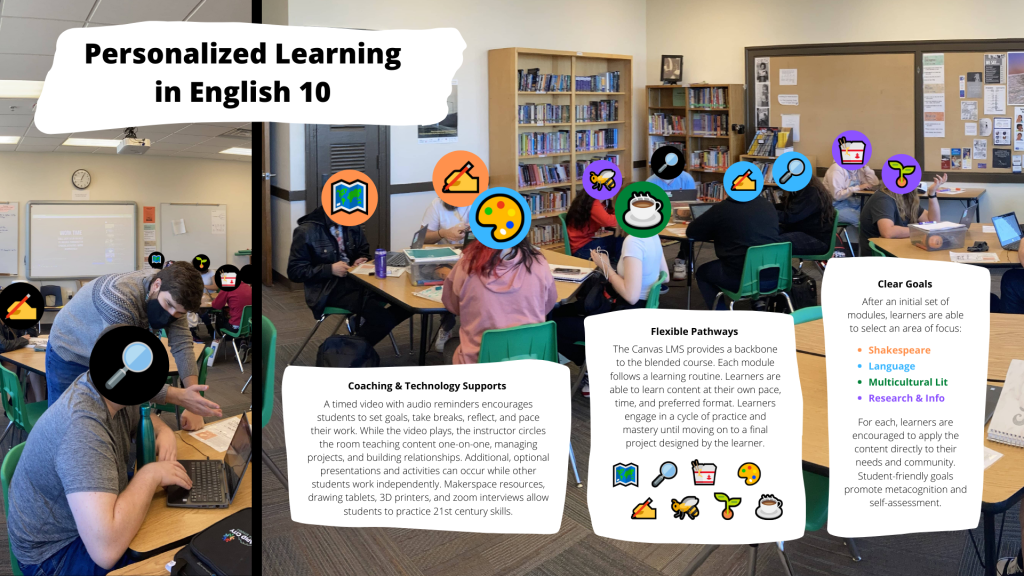
In the 2021-2022 academic year, I embarked on an ambitious journey to transform my English Language Arts instruction at Rapid City High School. The “Personalized ELA 10” project was born from a recognition that our traditional approach to teaching 10th grade English was failing to meet the diverse needs of our student population. This initiative aimed to shift from a one-size-fits-all model to a flexible, student-centered approach that would better serve our learners.
Pedagogical Foundations
The course was built on three key pedagogical approaches:
- Personalized Learning: This approach aspired to create a unique learning plan for every student, allowing for customization of learning path, pace, and mode of learning. It aligned with historical educational philosophies from Rousseau, Dewey, and Montessori.
- Blended Learning: The course utilized a blend of traditional classroom instruction and online technologies, most closely following a flipped classroom or FLEX approach. Students had access to all instruction, content, and assignments digitally, with in-person activities supplementing the online core.
- Mastery-Based Learning: Students were required to demonstrate mastery of skills before progressing, with assessments graded on a 4-point mastery scale. This approach emphasized the learning process over arbitrary time constraints.

Course Structure and Elements
The course was structured into 15 modules, with students selecting a personalized path for the final three of six completed.

Each module followed a consistent routine:
- Overview Page: Each module began with a clear articulation of the Course Learning Outcome (CLO), its relevance, and a brief video introduction.
- Pre-Assessment: Students could test out of a module by demonstrating mastery in a pre-assessment, typically an essay question applying the content to a real-life scenario.
- Lesson – Exploration: Students engaged in a structured exploration of the topic, following six learning steps inspired by the “Big 6” research method and KWL charts.
- Learning Community: A discussion board allowed students to share summaries and learn from peers.
- Practice Menu: Students could choose from various practice activities targeting specific components of the CLO.
- Check for Understanding: A short quiz with automatic feedback ensured students were ready for the final assessment.
- Assessment: The final project allowed students to demonstrate mastery in a variety of creative ways, such as interviews, dioramas, short films, op-eds, board games, and self-published poetry.

Innovative Elements
The course incorporated several innovative elements designed to enhance the learning experience:
- Teaching of Learner Agency Skills: The course explicitly taught skills like goal-setting, resilience, and metacognition.
- Physical Classroom Arrangement: The classroom was designed with flexible seating, a makerspace, and areas for different types of work.
- Goal Sheets: Students used daily goal sheets to plan their work and reflect on progress.
- Board Timer: A video-based timer helped structure the class period and guide students through daily routines.
- Grading Policy: The course used a mastery-based grading system, with only the final assessment impacting the module grade.

Challenges and Reflections
Throughout the implementation of Personalized ELA 10, several challenges emerged:
- Balancing flexibility and structure
- Ensuring equitable access to technology
- Managing diverse learning paces within a single classroom
- Adapting traditional assessment methods to a mastery-based system
These challenges prompted ongoing reflection and adjustment of the course design.
Key Takeaways for My New Role
The experience of designing and implementing Personalized ELA 10 has had a profound impact on my approach to instructional design and e-learning, particularly in my current work with adult learners. Some key takeaways include:
- Personalization Requires Clear Structure: The balance between flexibility and structure remains crucial in e-learning design. Clear pathways with individual choice options are essential.
- Technology as an Enabler: Technology should be a tool to enable personalization, not an end in itself. This principle guides the selection and implementation of learning technologies.
- Universal Value of Metacognition: The emphasis on reflection and learner agency skills has proven to be equally valuable for adult learners, informing my approach to designing self-directed learning experiences.
- Modular Design for Flexibility: The modular course structure has been invaluable in creating adaptable, easily updated online learning experiences for various clients and contexts.
- Authentic Assessment Drives Engagement: The focus on real-world application in assessments has directly influenced my approach to designing meaningful evaluations in corporate training contexts.
- Blended Approaches Enhance Learning: Strategies for balancing digital content with synchronous activities have informed my work in creating engaging e-learning modules and facilitating virtual workshops.
- Competency-Based Progression: The mastery-based learning concept has evolved into competency-based learning paths in corporate training, ensuring a solid foundation of knowledge across organizations.
- Learner Choice and Agency: The concept of learner choice remains central to my adult learning designs. I often create “learning playlists” in online courses, allowing adult learners to choose activities that best fit their learning style and work context.
- Adaptive Pre-Assessments: I’ve adapted the pre-assessment concept for adult learners, creating adaptive pre-assessments that allow experienced professionals to bypass familiar content and focus on areas for growth.
- Collaborative Learning Spaces: Online forums and collaborative spaces remain crucial in adult e-learning. I’ve expanded on this concept, creating virtual cohort experiences and facilitating peer-to-peer learning in corporate training programs.
Conclusion
The Personalized ELA 10 project was truly ahead of its time, embodying principles that have become central to effective online and adult learning. While the specific content and context have changed in my current work, the core philosophies of personalization, mastery-based progression, and learner agency have proven to be universally applicable.
This experience not only transformed my approach to teaching high school English but also laid the groundwork for my transition into e-learning consulting and instructional design for adult learners. It’s a powerful reminder that innovative educational practices can have far-reaching impacts, transcending age groups and learning contexts. As I continue to evolve my practice, the lessons learned from this project continue to inform and inspire my work in creating engaging, effective learning experiences for adult learners across various industries.
 Brady Licht