
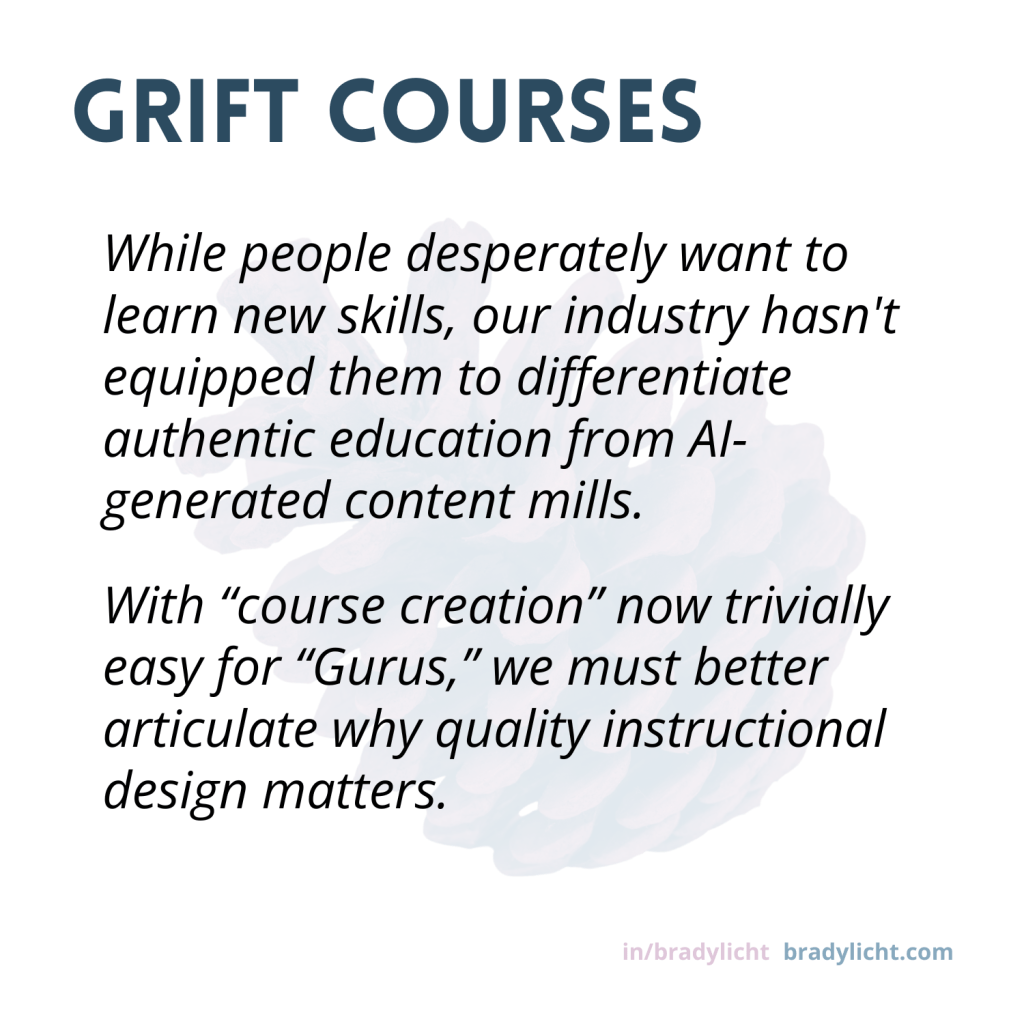
I’ve been watching the explosion of “guru” courses with growing unease. You know the type – flashy ads promising to teach you everything from digital marketing to life coaching in just a few hours of pre-recorded video content. While the sheer volume of these offerings suggests a healthy appetite for accessible learning, what I’m seeing should concern anyone who cares about educational quality.
The Real Problem
Many of these courses are little more than content dumps masquerading as educational experiences. I’ve reviewed dozens of them, and the pattern is depressingly familiar – a series of talking-head videos, maybe a PDF workbook, and perhaps a certificate that holds about as much value as the digital paper it’s printed on.
What frustrates me most is how this trend devalues the actual craft of online learning design. As someone who’s spent years studying and practicing instructional design, it’s disheartening to see complex pedagogical principles reduced to “just record some videos and upload them.”
The False Promise of Easy Learning
These courses often sell a dangerous myth:
- That learning is purely about content consumption
- That expertise can be gained through passive watching
- That education can be reduced to a series of bullet points
- That interaction and reflection are optional extras
I’ve seen the results of this approach firsthand – learners who complete these courses but struggle to apply their “knowledge” in real-world situations. They’ve consumed content but haven’t engaged in the deep learning experiences necessary for true skill development.
A Call for Change
As learning professionals, we need to take a stronger stance. It’s not enough to quietly maintain our standards – we need to actively:
- Call Out Poor Practice
- Challenge the “content equals learning” mindset
- Question superficial assessment methods
- Highlight the difference between consumption and learning
- Educate Stakeholders
- Show what real instructional design looks like
- Demonstrate the value of interactive learning
- Explain why proper assessment matters
- Set Clear Standards
- Define what quality online learning means
- Establish clear quality indicators
- Create frameworks for evaluation
What Now?
I remain optimistic about the potential of online learning, but we’re at a critical juncture. The demand for flexible, accessible education is valid – but our response to this demand matters immensely. We need to find ways to:
- Meet learner needs without compromising quality
- Leverage technology without letting it drive pedagogy
- Scale access while maintaining rigor
- Build trust in legitimate online credentials
I’m challenging my fellow learning professionals to take a stand:
- How are you maintaining quality in your work?
- What compromises are you unwilling to make?
- How do you communicate the value of proper design?
- What role will you play in shaping the future of online learning?
The answer to poor quality isn’t to retreat to traditional education models – it’s to demonstrate what quality online learning can and should be. We need to show that there’s a better way, even if it’s not the easier way.
 Brady Licht