
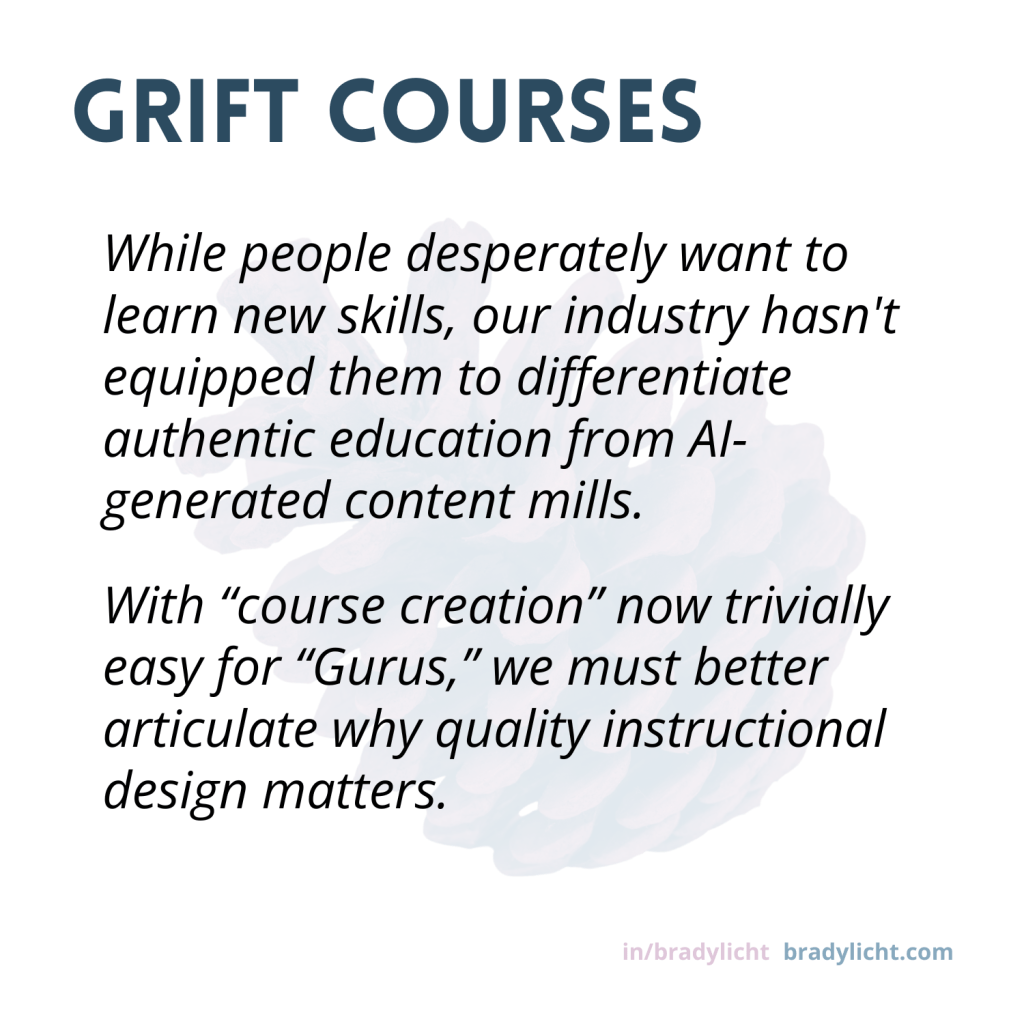
I have been watching the rise of “guru” courses with growing unease. You know the type: flashy ads promising to teach you everything from digital marketing to life coaching in a few hours of pre-recorded video. The number of these courses says something real, in that plenty of people want learning they can reach on their own schedule, and that demand is worth taking seriously. What gets sold to meet it is the problem.
What is actually wrong with these courses?
Many of them are content dumps dressed up as courses. The pattern is familiar to anyone who has clicked through one: a series of talking-head videos, maybe a PDF workbook, and a certificate worth about as much as the digital paper it is printed on.
What frustrates me most is how this devalues the craft of online learning design. After years of studying and practicing instructional design, it is hard to watch a whole body of pedagogical thinking get reduced to “just record some videos and upload them.”
What myth are they selling?
Underneath the format is a myth about how learning works, and it has a few parts: 1) learning is mostly consuming content, so a course’s job is to deliver information; 2) expertise comes from watching, which quietly takes practice out of the picture; and 3) education can be boiled down to bullet points without losing anything that mattered. Put those together and interaction and reflection start to look like optional extras, when they are where the learning actually happens.
The result is a gap between finishing a course and being able to do anything with it. Someone completes the videos, gets the certificate, and then finds that the situation in front of them looks nothing like the tidy examples on screen. They took in the content without ever being asked to use it, and using it was the point. I have made the same complaint about professional development in our own field, where seat time stands in for practice; I wrote about that in Let “EdTech” Training Die.
What can learning professionals do about it?
Keeping our own standards quietly is not enough while this goes on around us. A few things seem worth doing, and they build on each other: 1) naming poor practice when we see it, which means questioning the assumption that content equals learning, pushing back on assessments that check attendance rather than understanding, and saying plainly that watching a video is not the same as learning a skill; 2) helping the people who buy and commission this work see the difference, since most of them have no reason to know it, and showing them what real instructional design looks like gives them something to compare against in a way that complaining does not; and 3) setting standards concrete enough to use, such as a working definition of quality online learning, indicators someone can actually check, and ways to evaluate a course without needing a doctorate. That third one is part of why I wrote Homegrown Learning and gave it away, since a framework behind a paywall is not much use to the people most likely to be sold a bad course.
Where does that leave the rest of us?
I am still hopeful about online learning, and the demand for flexible, accessible education is legitimate. The open question is whether that demand gets met without giving up what makes online learning work, and that question applies to me as much as to anyone selling a guru course. How do you keep quality up when the pressure is to ship faster and cheaper? Which compromises will you refuse to make, and have you ever had to say so out loud? How do you explain the value of design to someone who only sees the invoice? I do not have tidy answers to those, and I am not sure anyone doing this work for a living does.
If you have found ways to answer any of them, I would like to hear about it. You can reach me at licht.education@gmail.com, and there are more tools, articles, and resources at bradylicht.com.

