

*Cover photo is of Andrew Ley, my colleague at BHSSC, conducting a demonstration of different use cases for ChatGPT during the Rapid City workshop.
Project Overview
In summer 2023, my colleague, Andrew Ley, and I collaborated with the University of South Dakota (USD), Dakota State University (DSU), and state educational organizations to develop and implement a series of AI integration workshops across South Dakota. These workshops aimed to address the emerging challenges and opportunities presented by generative AI tools in education, particularly focusing on responsible integration strategies for different educational roles.
Context and Need
The rapid emergence of tools like ChatGPT created both opportunities and challenges for educators. As DSU’s David DeJong noted during implementation, “We have more information at our fingertips than we’ve ever had before. We just need to get our teachers, principals, and superintendents into the habit of using artificial intelligence to make them better teachers.”
This initiative emerged at a crucial time when educators needed to balance AI’s potential benefits with maintaining educational integrity. As Brandon Valley Schools Superintendent Jarod Larson observed, “I do believe this firmly and wholeheartedly that never, ever, ever before has it been more important for educational systems to teach fundamental skills such as reading, writing, and math.”
Strategic Approach
Our approach centered on understanding AI integration as a complex change initiative requiring multiple pathways for different stakeholders. We developed two key methodological components:
World Café Methodology
We selected the World Café format specifically because AI integration represents a complex change scenario where:
- Solutions and definitions of success vary by context
- Multiple stakeholder perspectives needed to be considered
- The technology itself was rapidly evolving
- Implementation challenges varied across districts
The World Café discussions tackled pivotal questions about AI in education, including:
- Grading and differentiation approaches
- Ethical considerations
- Policy alignment
- Integration strategies for different roles and subjects
AI Playgrounds
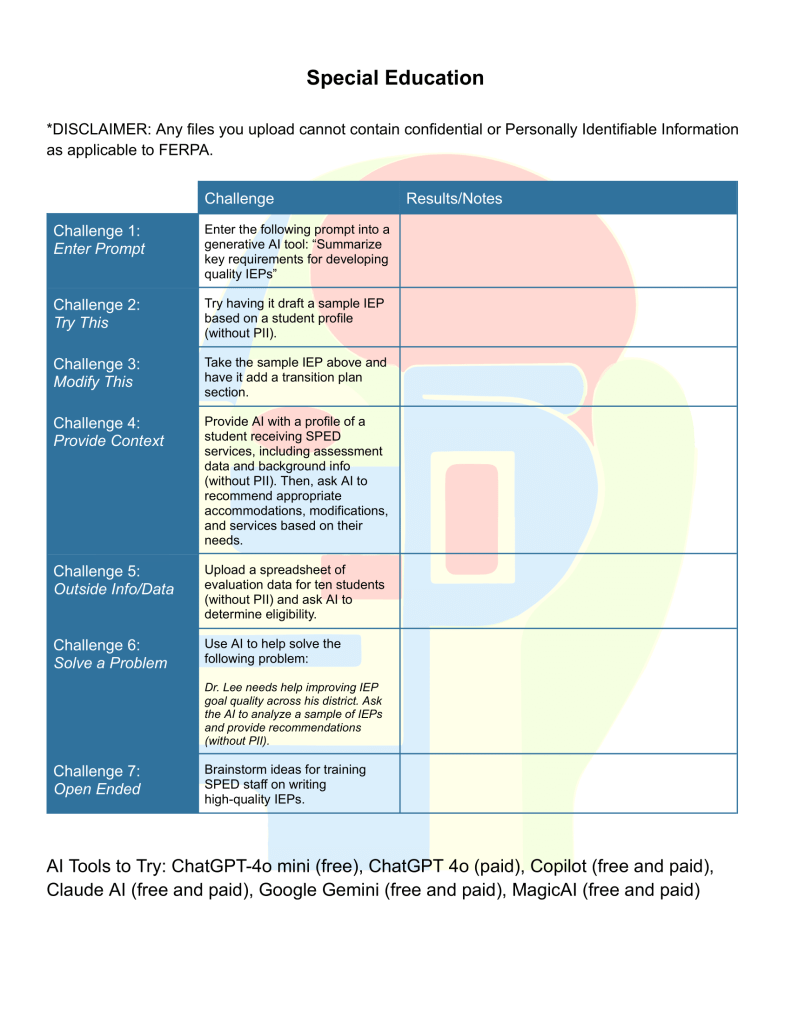
Working with my colleague Andrew Ley, we developed experiential learning stations that followed a gradual release model:
- Basic tool familiarization
- Guided use cases
- Role-specific applications
- Open-ended problem-solving
The playgrounds were specifically modeled on the Danielson Framework, and administrator uses, and other roles featuring tools including:
- ChatGPT
- MagicSchool AI
- Claude AI
- QuestionWell
- Twee
Implementation
The workshops were structured as full-day immersive experiences:
Morning Sessions:
- Welcome and AI fundamentals
- Educational potential demonstrations
- Hands-on AI Playground rotations
Afternoon Sessions:
- World Café discussions
- Deep dive into ethics, policies, and procedures
- Action planning for implementation
As Superintendent Larson reflected on the implementation approach: “I think about AI a little bit like I think about a microscope. You don’t use it every single day in bio; you use it when it is appropriate for the educational activity or the labs, so I think it is very important that we evaluate appropriate uses.”
Geographic Reach and Impact
The workshops were conducted across four strategic locations to ensure statewide access:
- Rapid City (September 7)
- Aberdeen (September 14)
- Harrisburg (September 19)
- Chamberlain (September 26)
This geographical distribution helped ensure equitable access to professional development across the state’s educational community.
Addressing Complex Change
The workshops acknowledged several layers of complexity:
- Varying District Needs As Larson noted, schools needed to “evaluate appropriate uses” rather than adopt one-size-fits-all solutions.
- Technical Readiness DeJong demonstrated this during workshops, showing how AI could generate teaching resources: “If you know which questions to ask, you can ask them to generate, and then it just lists the questions.”
- Student Use Considerations DeJong highlighted this challenge: “Now students are just asking Chat GTP to write papers for them and they are trying to figure out how to get away with submitting artificial intelligence work into their classroom and that in education is something we relied on a lot is for people to think and write, you know the game just changed.”
Workshop Evaluation
The full exit survey results can be found below with key insights following after.
Impact on AI Understanding
One of the most significant outcomes was the shift in participants’ familiarity with AI concepts. Pre-workshop responses showed many participants self-identifying as “Slightly familiar” or “Not familiar at all” with AI concepts. Post-workshop data indicated a marked increase in comfort levels, with most participants moving to “Moderately familiar” or “Very familiar.”
Most Valuable Components
The survey data revealed which workshop elements participants found most beneficial:
- AI Playground Stations (99 mentions)
- Demonstration Sessions (93 mentions)
- World Café Discussions (92 mentions)
- Introduction/Panel Discussions (70 mentions)
This validates our complex change approach, showing that participants valued both hands-on experimentation and collaborative discussion opportunities.
Notable Participant Feedback
Several key themes emerged from the qualitative feedback:
From administrators: “This was very help to start conversations and learning. I would love to have the opportunity to come back together and discuss what we are all doing and how it is working.”
From teachers: “I am not sure… this is all mind-blowing. I need to process.”
From technology leaders: “Create a email group that sends out tips and tricks to those subscribers to help us keep up with the latest and greats tools, tips and trick to use AI. Similar to your Facebook group.”
Implementation Priorities
Participants consistently ranked these factors as critical for AI implementation:
- Data privacy and security
- Training and professional development
- Integration with existing systems
- Ethical considerations
- Cost and budget constraints
Future Support Needs
Participants identified several key resources needed for successful implementation:
- AI training programs for district staff
- Policy and guidelines for AI use in education
- Participation in communities of practice
- Access to AI experts and consultants
- Collaboration opportunities with other districts
Challenges Identified
Several challenges emerged from the feedback:
- Time constraints: “More time in the AI playground. It was very informative”
- Policy development needs: “Is the state going to provide some guidelines?”
- Integration concerns: “Teachers need time to work with this technology so that they are ready for it in their classrooms.”
Looking Back: September 2023 to Present (12/19/24)
Evolution of the AI Landscape
- Tool Evolution and Accessibility
- The emphasis on prompt engineering has decreased as AI tools have become more intuitive
- Many educational platforms now offer built-in AI features with teacher-specific interfaces
- Integration of AI tools into existing educational platforms has simplified implementation
- The rise of specialized education-focused AI tools has reduced the need for complex prompt crafting
- Changed Professional Development Needs
- Less focus needed on technical aspects of AI use
- Greater emphasis required on pedagogical integration and student AI literacy
- Shift from “how to use” to “when and why to use” in professional development
- Increased need for ethical framework development as tools become more accessible
What I Would Update
- Content Focus
- Reduced time on prompt engineering basics
- Increased focus on evaluating AI-generated content
- More emphasis on developing student AI literacy
- Greater attention to workflow integration rather than tool mastery
- Structure Adjustments
- More demonstration of real classroom implementations
- Additional emphasis on student training and AI literacy development
Current Challenges and Opportunities
- Integration Challenges
- Managing the rapid proliferation of AI tools
- Balancing accessibility with responsible use
- Creating flexible policies that can adapt to rapid changes
- Emerging Opportunities
- More sophisticated tools for personalized learning
- Better integration with existing educational technologies
- Enhanced capabilities for administrative tasks and automation
This retrospective view highlights both the prescience of our original approach in addressing AI as complex change and the need for continued evolution in our professional development approaches. The fundamental principles of our workshop design – emphasizing hands-on experience, collaborative learning, and ethical consideration – remain relevant, even as the specific content and focus areas require updating to match the current state of AI in education.
 Brady Licht