

*Cover photo is of Andrew Ley, my colleague at BHSSC, demonstrating different use cases for ChatGPT during the Rapid City workshop.
A four-stop statewide workshop series that treated AI integration as a complex change problem, combining World Café discussions with hands-on AI Playground stations to give South Dakota educators role-specific entry points into generative AI.
- Project Type: Statewide professional development workshop series on AI integration
- Audience/Client: South Dakota K-12 educators, administrators, and technology leaders
- Timeline: Summer-Fall 2023 (with later iterations through 2024)
- Role: Co-designer and co-facilitator
- Collaborators: Andrew Ley (BHSSC); University of South Dakota; Dakota State University; state educational organizations
- Format & Deliverables: Four full-day in-person workshops across South Dakota; AI Playground experiential stations modeled on the Danielson Framework; World Café discussion sessions; action planning materials
The Situation
By summer 2023, ChatGPT had been public for less than a year and South Dakota schools were already feeling it. Teachers were seeing AI-written assignments, administrators were being asked for policy they didn’t have, and most educators had barely tried the tools themselves. There was no single right answer to hand them, since what made sense depended on the district, the role, and the subject, and the technology was changing month to month.
The Approach in Brief
My colleague Andrew Ley and I, working with the University of South Dakota, Dakota State University, and state educational organizations, treated AI integration as a complex change problem rather than a training topic. That meant two things. Hands-on AI Playground stations, organized around the Danielson Framework and other roles, gave each person an entry point tied to their own work, and a World Café in the afternoon let districts work through the questions that had no single answer, such as grading, ethics, and policy, with each other rather than waiting on us.
What Came Out of It
We ran full-day workshops in Rapid City, Aberdeen, Harrisburg, and Chamberlain in September 2023, so educators in every part of the state could attend without a long drive. On the exit survey, many participants who came in describing themselves as slightly or not at all familiar with AI left describing themselves as moderately or very familiar. When asked what helped most, they named the AI Playground stations (99 mentions), the demonstrations (93), the World Café discussions (92), and the introductory panel (70). Their top implementation priorities were data privacy and security, followed by training, integration with existing systems, ethics, and cost, and the most common request was for more: more time in the playgrounds, state guidance on policy, and a way to keep meeting to compare what districts were trying.
Key Takeaway
When a change has no settled answer, the most useful thing a workshop can do is give people a real first experience and a structured way to think it through together. Participants valued the discussion nearly as much as the hands-on time, which says something about what they were missing.
Deeper Context
The audience ranged from classroom teachers to superintendents and technology directors, and they came with very different worries. Some leaders were enthusiastic about what the tools could do for teachers, while others worried about what they would do to the basics, with one superintendent arguing that reading, writing, and math had never mattered more. The same superintendent offered a comparison we came back to often: AI is a bit like a microscope in a biology class, useful when the activity calls for it rather than every day. That idea of evaluating appropriate uses, instead of adopting or banning wholesale, shaped the whole design.
The Journey
We chose the World Café because AI integration had all the marks of complex change: what counted as success varied by context, many stakeholder perspectives needed a hearing, the technology kept moving, and every district faced different implementation problems. A format built around rotating table conversations let a superintendent from one side of the state hear how a teacher from the other side was handling the same question.
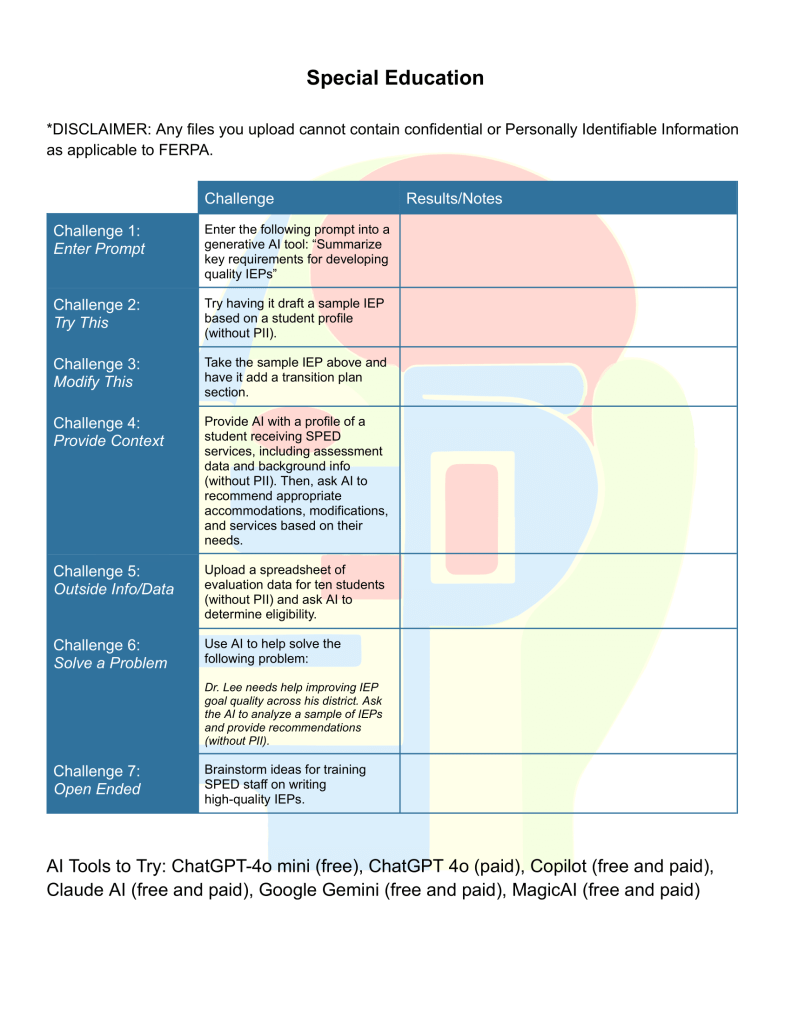
The AI Playgrounds followed a gradual release model: 1) basic familiarity with a tool, 2) guided use cases, 3) applications specific to a role, and 4) open-ended problem-solving. Stations were organized around the domains of the Danielson Framework for teachers, along with administrator uses and other roles, and used tools including ChatGPT, MagicSchool AI, Claude, QuestionWell, and Twee. Organizing by the Danielson domains meant a teacher could start from a part of their practice they already knew rather than from the tool.
The day ran in two halves. Mornings covered AI fundamentals, demonstrations of what the tools could do in schools, and rotations through the playgrounds. Afternoons moved to the World Café, a deeper look at ethics, policy, and procedures, and time for each district to plan its next steps. Feedback afterward captured the range in the room, from an administrator who wanted a chance to reconvene and compare notes, to a teacher who said it was a lot and needed time to process, to a technology leader asking for an ongoing email list of tips.
The Work Itself
The special education playground station above is one example of the station design. The full exit survey results are available below.
What I’d Change
Looking back from December 2024, the tools had already changed enough to change the workshop. Prompt engineering mattered less as tools became easier to use and as AI features showed up inside platforms teachers already had. I’d spend much less time on prompting basics and more on evaluating what AI produces, on student AI literacy, and on how the tools fit into real workflows, shifting the emphasis from how to use them to when and why. I’d also show more examples from actual classrooms and fewer demonstrations.
Reading the case now, the playground rotations also look closer to a tool tour than I’d like. In Let “EdTech” Training Die I wrote that AI training was repeating the app-dump era, with facilitators, myself included on some days, demonstrating tools at a rapid-fire pace, and these workshops were part of that pattern. My broader view of AI in schools has also grown more skeptical since 2023, with more weight on environmental cost, dependence on a handful of vendors, and keeping human judgment at the center. A version of this workshop today would give more of the day to the World Café questions and to whether a given use is worth it at all.
Connections
For a later AI session that used the same World Café approach with librarians, see the Keynote at the Black Hills Library Mini-Conference. For how my thinking on AI and game design shifted over the same period, see Second Thoughts on AI-Assisted Game Design in K12. If you’re planning AI professional learning for a district or region, you can reach me at licht.education@gmail.com, and there are more tools, articles, and resources at bradylicht.com.

