
Working with educational systems across the Great Plains, I’ve witnessed a troubling pattern: traditional professional development approaches are failing to address the mounting challenges facing educators today. But here in the Black Hills, we have a unique opportunity to design learning experiences that work where educators actually are both professionally and geographically.
The Problem
Teacher burnout rates have reached crisis levels. Staff cohesion suffers when teachers feel isolated and overwhelmed. Turnover disrupts learning communities and exhausts remaining staff who must constantly rebuild relationships and systems.
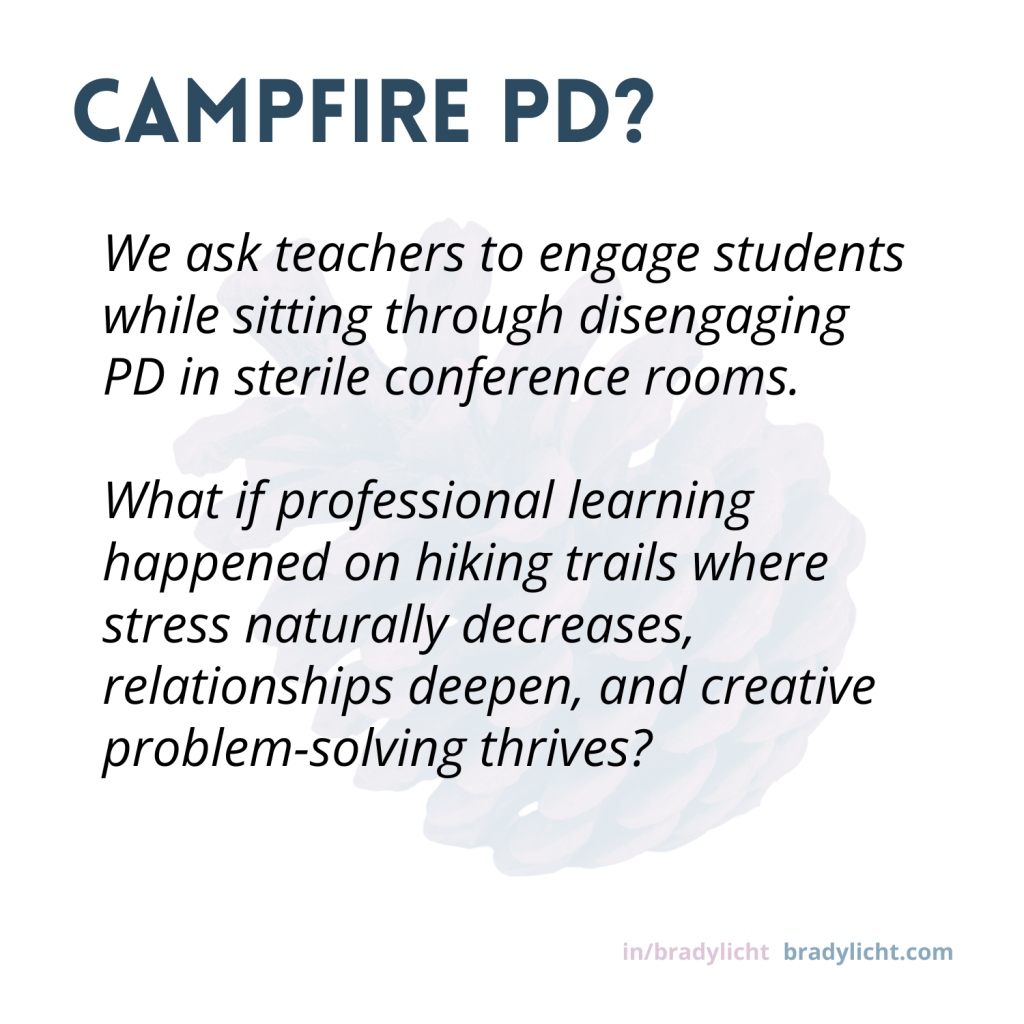
Traditional professional development often compounds these problems rather than solving them. Sitting through sessions in sterile conference rooms, listening to presentations about student engagement while feeling completely disengaged ourselves, then returning to classrooms with little that addresses real challenges: stress, isolation, creative exhaustion, and disconnection from the joy that brought us to education.
The result? Professional development that feels like another task to endure rather than an opportunity for growth and renewal.
The Solution
Here in the Black Hills, we’re surrounded by something most educational regions lack: hundreds of miles of hiking trails, natural spaces, and outdoor environments that can transform how we approach professional learning.
Outdoor professional development means taking your existing professional learning objectives and facilitating them through structured outdoor experiences. Let me be explicit about what this looks like:
- Curriculum Design Hikes: 4-hour sessions combining trail walking with collaborative lesson planning, using natural observation to inspire cross-curricular connections and place-based learning opportunities.
- Leadership Development Backpacking: Multi-day experiences for administrative teams where groups practice collaborative decision-making, resource management, and problem-solving under changing conditions.
- New Teacher Mentoring Walks: Monthly guided hikes pairing experienced and novice teachers, building relationships while discussing classroom management, student engagement, and professional growth in a supportive, non-hierarchical environment.
- Biomimicry Innovation Sessions: Half-day experiences where teams observe natural systems (ant colonies, ecosystem relationships, adaptive strategies) and translate those patterns into solutions for classroom collaboration, student engagement, or school culture challenges.
This isn’t about abandoning rigorous professional development for nature walks. Every session maintains clear learning objectives, structured activities, and measurable outcomes while leveraging the proven benefits of natural environments for creativity, stress reduction, and relationship building.
Now, I recognize I’m fortunate to live in the Black Hills where extensive trail systems and natural spaces make outdoor professional development particularly accessible. This geographic advantage has inspired me to advocate for districts to explore nature-based approaches to professional learning. But here’s the important point: you don’t need mountains and miles of hiking trails to implement outdoor professional development effectively.
Urban districts can achieve similar benefits using city parks, botanical gardens, riverside trails, even school courtyards or outdoor spaces. The key principles such as movement, natural environments, collaborative problem-solving, and stress reduction work whether you’re hiking the Centennial Trail or walking through Central Park. What matters is intentionally designing professional learning experiences that get educators outside, moving, and connecting with each other in environments that naturally support creativity and wellness.
The Rationale
The research supporting nature-based professional development is compelling, particularly for addressing educator burnout and building staff cohesion.
- Mental health and stress reduction: Studies demonstrate significant decreases in cortisol levels after just 15 minutes in natural environments. Teachers participating in forest bathing programs report decreased stress levels and improved mental wellbeing. In our profession where chronic stress contributes directly to burnout, this isn’t just nice-to-have.
- Enhanced creativity and problem-solving: A University of Kansas study found 50% improvements in creative problem-solving abilities after four days of nature immersion. Even shorter outdoor sessions show substantial gains in innovative thinking.
- Stronger professional relationships: Outdoor environments naturally reduce hierarchy and status differences while encouraging diverse participation patterns. When we hike together, solve problems using natural materials, or observe ecosystem patterns as metaphors for classroom dynamics, we’re building the trust and collaboration that improve staff cohesion and reduce turnover.
- Transferable resilience skills: Learning to adapt to changing weather, navigate uncertain terrain, and find creative solutions with limited resources develops the adaptive thinking educators need in today’s educational landscape. These experiences build confidence and resilience that extend far beyond the hiking trail.
The neurological mechanisms are clear: outdoor environments activate the brain’s default mode network while reducing activity in regions associated with rumination and depression. This creates optimal conditions for the kind of reflective thinking and collaborative problem-solving that effective professional development requires.
Implementation Example: Getting started in the Black Hills
Given our geographic advantages, here’s a practical framework for implementing outdoor professional development:
Phase 1: Start with accessible local trails
- Locations to consider: Falls Park area for easy accessibility, Dinosaur Park trails for moderate hiking with great views, or Rapid Creek Greenway for flat, accessible options. Choose locations based on your group’s physical abilities and comfort levels.
- Session structure: Begin with 2-3 hour sessions combining 45 minutes of guided hiking with focused professional dialogue, 30 minutes of nature-based activities directly connected to learning objectives, and 45 minutes of collaborative problem-solving using outdoor settings.
- Learning objectives: Start with topics that naturally connect to outdoor experiences: stress management strategies, building resilience, team collaboration, or creative problem-solving approaches.
Phase 2: Develop facilitator capacity
- Partner with local organizations: Black Hills National Forest, Great Plains Zoo & Delbridge Museum, or local environmental education groups can provide expertise and support.
- Train internal facilitators: Develop teacher leaders who can facilitate outdoor sessions using structured frameworks that others can adapt and replicate.
- Safety and logistics: Establish protocols for weather contingencies, communication, first aid, and risk management appropriate for your specific locations and activities.
Phase 3: Integrate with existing professional development
- Curriculum connections: Use hiking experiences to explore cross-curricular teaching, place-based education, or environmental science integration.
- Leadership development: Multi-day backpacking experiences for administrative teams can build trust and collaborative decision-making skills.
- New teacher mentoring: Pair experienced and new teachers for outdoor experiences that build relationships while addressing professional growth goals.
Phase 4: Scale systematically
- Seasonal programming: Take advantage of different seasonal opportunities such as winter snowshoeing for resilience building, spring hiking for renewal and goal-setting, fall experiences for reflection and planning.
- Community partnerships: Develop relationships with local outdoor recreation businesses, environmental organizations, and tourism groups who can provide resources and expertise.
- Assessment and refinement: Use pre/post surveys, behavioral observations, and retention data to measure effectiveness and continuously improve programming.
Addressing practical concerns
- Weather contingencies: Develop programming that embraces weather as learning opportunity rather than obstacle. Some of the most powerful team-building happens when groups adapt to unexpected conditions together.
- Physical accessibility: Design multiple participation options, from challenging backcountry hikes to accessible nature center programs, ensuring everyone can engage meaningfully.
- Professional rigor: Maintain focus on specific learning outcomes using the same assessment strategies you’d apply to any professional development, with clear connections between outdoor experiences and classroom application.
Creating sustainable change
What excites me about outdoor professional development is its potential to address root causes rather than symptoms. Instead of trying to motivate burned-out teachers through traditional presentations, we’re creating conditions that naturally restore energy, build relationships, and inspire innovation.
Here in the Black Hills, we have natural assets that most educational regions lack. The question isn’t whether we can afford to explore outdoor professional development; it’s whether we can afford not to when teacher mental health, staff cohesion, and retention are such critical challenges.
 Brady Licht