Working with educational systems across the Great Plains, I keep running into the same pattern: the way we usually do professional development doesn’t touch the problems educators are actually carrying. Here in the Black Hills, though, we have an unusual opportunity to design learning that meets educators where they are, both professionally and geographically.
What’s wrong with PD as usual?
Burnout comes up in nearly every district conversation I’m part of. Staff cohesion suffers when teachers feel isolated and overwhelmed, and turnover disrupts learning communities and wears down the staff who stay and have to rebuild relationships and systems again and again.
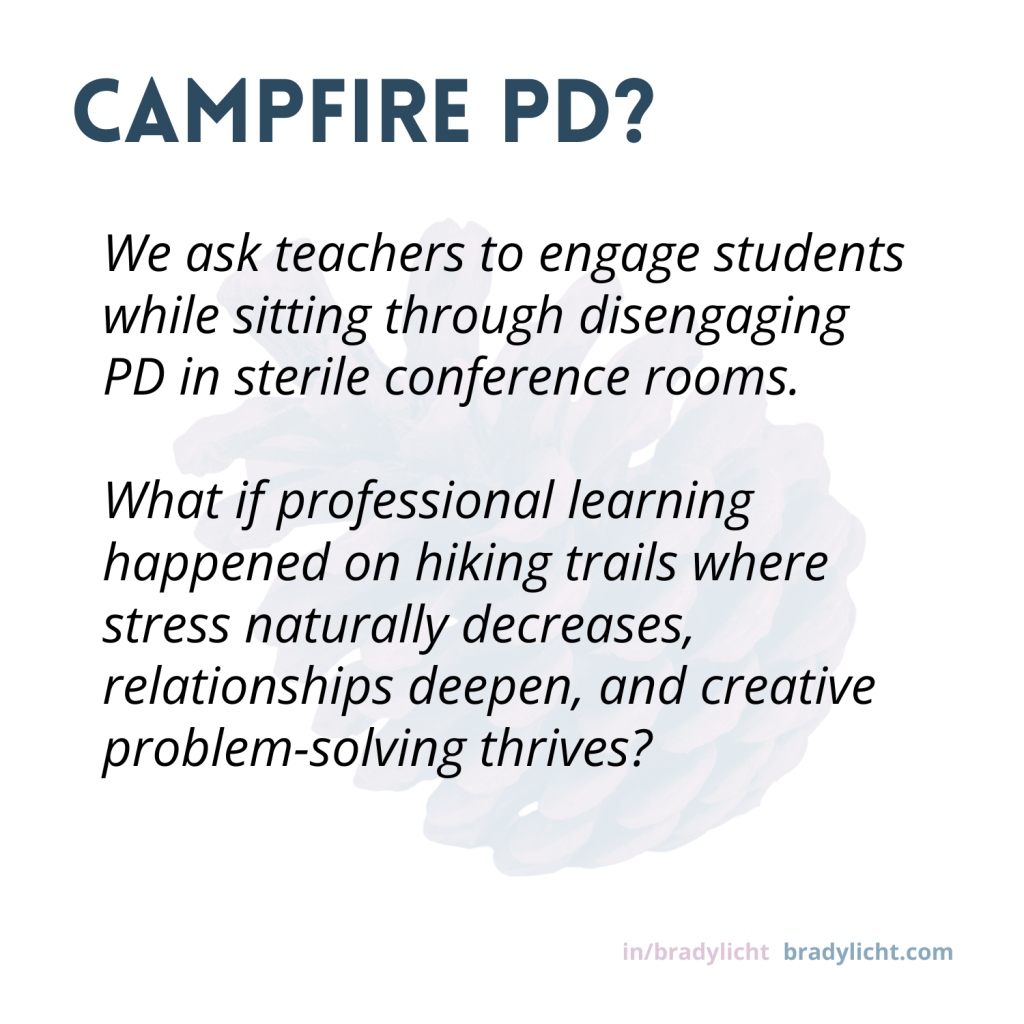
Traditional professional development often makes this worse. We sit in a conference room listening to a presentation about student engagement while feeling disengaged ourselves, then go back to our classrooms with little that speaks to the stress, isolation, creative exhaustion, and loss of joy that are wearing us down in the first place. As such, PD ends up feeling like one more thing to get through rather than a chance to grow.
What does outdoor PD look like?
Here in the Black Hills, we’re surrounded by something most regions don’t have: hundreds of miles of trails and a great deal of open, natural space. Outdoor professional development means taking the learning objectives you already have and facilitating them through structured experiences outside. A few formats I have in mind:
- Curriculum Design Hikes: 4-hour sessions combining trail walking with collaborative lesson planning, using what people observe along the way to spark cross-curricular connections and place-based learning.
- Leadership Development Backpacking: Multi-day trips for administrative teams where groups practice collaborative decision-making, resource management, and problem-solving as conditions change.
- New Teacher Mentoring Walks: Monthly guided hikes pairing experienced and new teachers, building relationships while talking through classroom management, student engagement, and professional growth outside the usual hierarchy.
- Biomimicry Innovation Sessions: Half-day sessions where teams observe natural systems (ant colonies, relationships within an ecosystem, adaptive strategies) and translate those patterns into ideas for classroom collaboration, student engagement, or school culture.
None of this means trading rigorous professional development for a nature walk. Each session keeps clear learning objectives, structured activities, and a plan for checking whether it worked, and it uses the setting for what the setting is good at: creativity, stress reduction, and relationship building.
I’ll admit I’m fortunate to live in the Black Hills, where the trail systems make this unusually easy, and that’s a big part of why I’ve started advocating for it. You don’t need mountains to do it well, though. Districts elsewhere can get many of the same benefits from city parks, botanical gardens, riverside trails, or even a school courtyard. Movement, a natural setting, and collaborative problem-solving work whether you’re on the Centennial Trail or in Central Park. What matters is deliberately designing professional learning that gets educators outside, moving, and talking with each other.
What does the research say?
The research on time in nature isn’t about teachers specifically, but it bears directly on stress and creative thinking. In a set of field experiments across 24 forests in Japan, Park and colleagues (2010) found that roughly fifteen minutes of walking and fifteen minutes of viewing a forest led to lower salivary cortisol, pulse rate, and blood pressure than the same activities in a city. For a profession where chronic stress drives burnout, that isn’t a minor detail.
On creativity, Atchley, Strayer, and Atchley (2012), psychologists at the University of Kansas and the University of Utah, found that Outward Bound backpackers scored about 50 percent higher on a creative problem-solving test on the fourth day of their trip than people who hadn’t started yet. The authors are careful to note that their design can’t separate the effect of nature from the effect of being away from screens, which is worth keeping in mind before promising a district the same result from an afternoon hike. Bratman and colleagues (2015) offer a possible mechanism on a shorter timescale: a 90-minute walk in a natural setting reduced both self-reported rumination and activity in the subgenual prefrontal cortex, a brain region linked to rumination, while the same walk along a busy road did not.
The other benefits I’d point to come more from experience than from studies. Being outside together tends to flatten hierarchy and draw in people who stay quiet in a conference room, and hiking together, solving problems with what’s at hand, or using an ecosystem as a metaphor for classroom dynamics builds the kind of trust that holds a staff together. Adapting to changing weather, uncertain terrain, and limited resources also asks for the same adaptive thinking educators need back at school, and that confidence tends to travel with people off the trail.
Implementation Example: Getting started in the Black Hills
Given what we have access to here, this is how I’d phase it in.
Phase 1: Start with accessible local trails
Start close to home and easy on the legs. The Rapid Creek Greenway offers flat, accessible options, and the trails around Dinosaur Park offer moderate hiking with good views, so choose based on your group’s physical abilities and comfort. A first session can run two to three hours: 1) 45 minutes of guided hiking with focused professional dialogue, 2) 30 minutes of nature-based activities tied directly to the learning objectives, and 3) 45 minutes of collaborative problem-solving outside. Begin with topics that connect naturally to the setting, such as stress management, resilience, team collaboration, or creative problem-solving.
Phase 2: Develop facilitator capacity
Next, build the people who can run it. Partners like the Black Hills National Forest and local environmental education groups can provide expertise and support. Develop teacher leaders who can facilitate outdoor sessions using structured frameworks that others can adapt, and set protocols for weather, communication, first aid, and risk management that fit your specific locations and activities.
Phase 3: Integrate with existing professional development
Once the basics are in place, connect outdoor sessions to the PD you already run. Hikes can anchor work on cross-curricular teaching, place-based education, or environmental science. Multi-day backpacking can build trust and shared decision-making for administrative teams, and outdoor pairings can give new teacher mentoring a regular rhythm.
Phase 4: Scale systematically
From there, plan around the seasons (winter snowshoeing for resilience, spring hikes for renewal and goal-setting, fall outings for reflection and planning), build relationships with local outdoor recreation businesses and environmental organizations, and use pre/post surveys, observation, and retention data to see whether it’s working and adjust.
What about the practical concerns?
Weather is the first thing people bring up, and it’s worth planning for rather than around, since some of the best team-building happens when a group adapts to unexpected conditions together. Physical accessibility matters just as much, so offer a range of options from challenging backcountry hikes to accessible nature center programs, and make sure everyone can take part in a real way. Finally, keep the professional rigor: hold outdoor sessions to the same learning outcomes and assessment you’d use for any PD, with clear connections back to the classroom.
Creating sustainable change
What interests me most about outdoor professional development is that it goes after causes rather than symptoms. Instead of trying to motivate burned-out teachers with another presentation, it creates conditions that restore energy, build relationships, and make room for new ideas.
Here in the Black Hills, we have natural assets most regions lack. Given where teacher mental health, staff cohesion, and retention stand, the question I keep coming back to is less whether districts can afford to try this than what it costs them to keep doing PD the way they do now.
If you’ve taken professional learning outside, or want to try, I’d like to hear about it. You can reach me at licht.education@gmail.com, and there are more tools, articles, and resources at bradylicht.com.

