
Resources for two conference sessions. One looks at ant colonies and course design. The other looks at honeybee swarms and group decisions. Both come from the same root of biomimicy as design inspiration, so they live on one page.
What biomimicry means here
Biomimicry (in our simplified framework) means borrowing the principles behind what nature does, not copying how it looks. A colony or a hive solves a hard problem with no manager and no master plan, and the useful part is the rule it follows, not the animal that follows it.
Two cautions keep this honest. Nature optimizes for survival, not for learning or good meetings, so natural does not mean better on its own. And any pattern from nature has to be checked against what we already know about how people learn and decide, rather than treated as an instruction manual.
Biomimicry is simply inspiration and not a replacement for learning sciences. For a quick overview of the practice, take a look at a short session of mine from last year’s ISTE.
What makes these two examples worth borrowing is a single idea. Simple local rules and shared signals can add up to intelligent behavior across a whole group, with no one in charge. The two sessions below apply that idea in different places. The ant colony applies it to content and analytics. The honeybee swarm applies it to people and decisions.
For more articles on biomimicry in education and learning design: https://bradylicht.com/tag/biomimicry/
Jump to a session
- Swarm Analytics: what ants can teach us about course design
- Bee Democracy: what a beehive knows about your next big decision
- Combined References
Swarm Analytics: what ants can teach us about course design
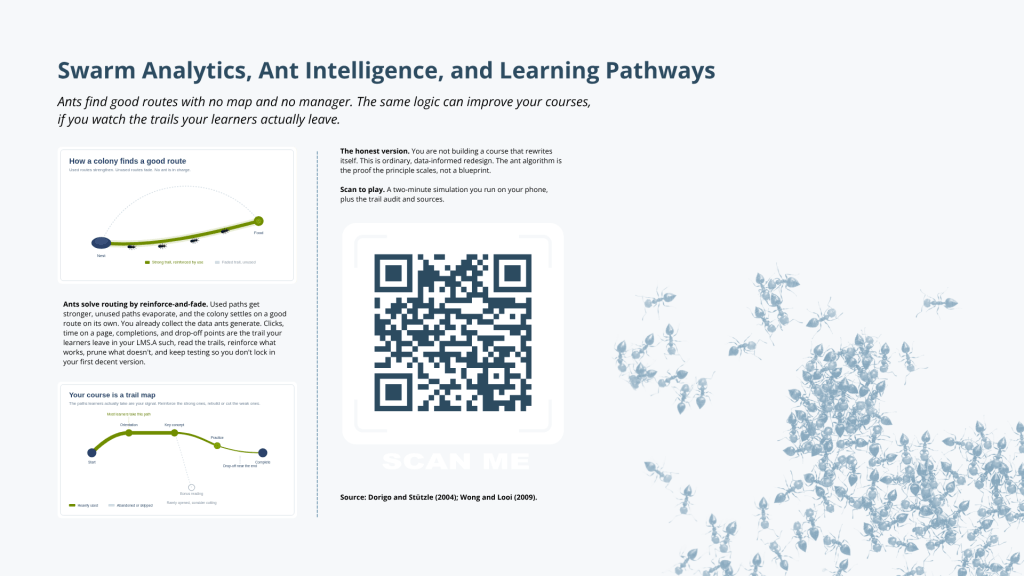
A single ant is not impressive. A colony is. Drop a food source near an ant nest and within hours the colony will have found one of the shorter routes to it, with no map, no manager, and no plan. That capability points at a practical idea for anyone who designs learning.
Play it first
Before reading further, run the two-minute simulation. Watch the colony settle on a good route, then change one setting and watch it lock onto a poor one. That single move is the whole argument of this section.
How the colony does it
Ants moving between the nest and a food source lay down a chemical trail called pheromone. Other ants tend to follow stronger trails, and because shorter routes get walked more often in the same amount of time, they accumulate pheromone faster. Trails that go unused evaporate. The result is a feedback loop that reinforces good routes and lets bad ones disappear. Computer scientists formalized this into ant colony optimization, and the balance between following known trails and exploring new ones is what keeps the colony from settling on a route that is merely acceptable rather than good. (Dorigo and Stützle, 2004)
It has already reached education
This is not just a metaphor. Researchers have used ant colony optimization to recommend learning paths and to sequence learning objects, treating the choices of many learners as the signal that strengthens the better routes through a body of content. (Wong and Looi, 2009; research on ant colony systems for adaptive learning object recommendation, Expert Systems with Applications, 2008)
The honest translation
You are not going to run an algorithm on your course, and you do not need to. The transferable idea is simpler and well supported by the learning analytics literature: design iteratively, watch what learners actually do, reinforce the paths that work, and let the weak ones fade. Studies of instructors using analytics to revise their courses find they make data-informed changes from the course level down to the activity level, and that engagement tends to stabilize after about three rounds of revision. (From Data to Design, LAK Conference, 2025) The pheromone idea adds one discipline that is easy to skip: keep testing alternatives. Evaporation is what prevents premature convergence, and the human equivalent is refusing to freeze your first decent version.
The method
Read the trails your learners leave, which are the engagement signals already in your LMS. Reinforce the routes that show both use and learning. Prune or rebuild the routes learners abandon. Keep a few alternatives in play each cycle. The course gets better across cohorts the same way a trail does, by accumulating evidence rather than by being planned perfectly up front.
| Ant concept | Your analytics signal | What you do |
|---|---|---|
| Pheromone trail | Clicks, time, completions | Notice which paths get used |
| Trail reinforcement | High use and high learning | Build on what works |
| Evaporation | Stale, unused content | Retire or refresh it |
| Exploration | Untested alternatives | Keep a few in play |
| Colony convergence | Iterative redesign | The design improves across cohorts |
Try It: the Course Trail Audit
Use this to turn what your learners actually do into one decision to reinforce and one decision to prune.
- Your course at a glance. List your modules or major activities as nodes.
- The trails. For each node, note one signal you can actually see: completion rate, time spent, drop-off point, revisits, or help requests.
- Strongest trail. Which path do learners complete and engage with most, and what makes it work?
- Weakest trail. Which path do learners abandon, skip, or struggle through?
- Reinforce. Pick one strong path. How will you extend or build on it?
- Prune or redesign. Pick one weak path. Will you cut it, shorten it, reorder it, or rebuild it?
- Keep testing. Name one alternative you will try next cycle, so you do not freeze on the current design.
What this does not claim
Nature optimizes for survival, not for learning outcomes, and an ant trail is a poor model for everything a course needs to do. The colony is an existence proof that decentralized, evidence-driven improvement works at scale, and a useful prompt for how to think about your own data. It is not a substitute for instructional design judgment.
Take the poster with you
Bee Democracy: what a beehive knows about your next big decision
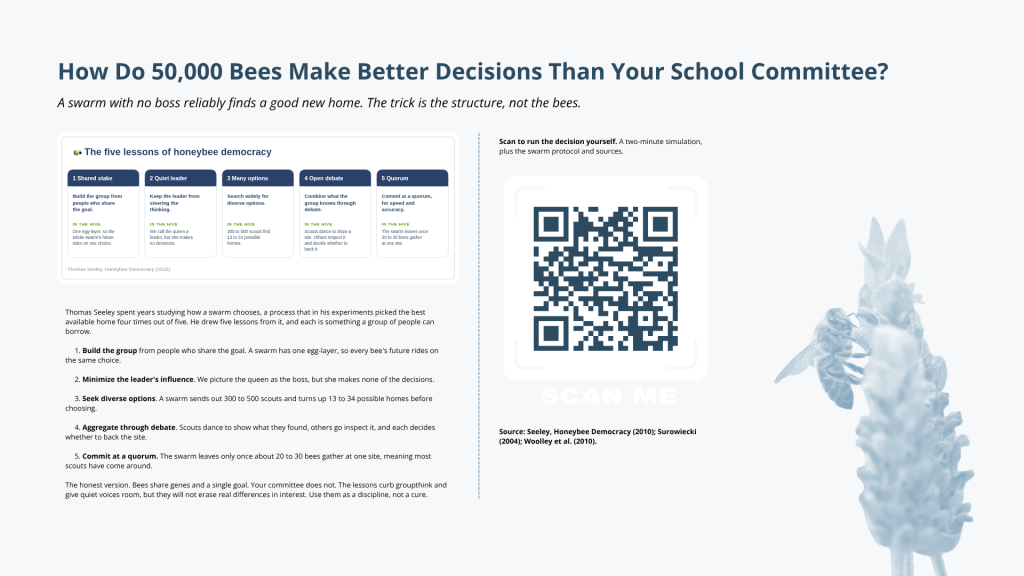
Every summer a healthy honeybee colony outgrows its home and splits. Tens of thousands of bees cluster on a branch while a few hundred scouts go looking for a new place to live. Within a day or two, with no leader directing the choice, the swarm picks a site and flies to it. Thomas Seeley spent years working out how, and the answer is a decision process worth borrowing.
Play it first
Before reading further, run the two-minute simulation. Watch the swarm choose a good home on its own, then add a loud leader or turn off the fade and watch it choose badly. That is the honest caveat in action.
How the swarm decides
Scout bees fly out and assess candidate sites on their own. A scout that finds a promising cavity returns and advertises it with a waggle dance, and the vigor of the dance reflects how good she judges the site to be. Other uncommitted scouts go check it for themselves. Two features make this work. Each dance fades over time, so no option survives on stubbornness alone. And the swarm commits through quorum sensing: once enough scouts gather at one site, the bees there change their behavior and the swarm prepares to move. In a controlled test with one ideal site and four merely acceptable ones, four of five swarms chose the best option. (Seeley, 2010)
The four steps
The process simplifies to four steps that are easy to remember and to run: Scout, Report, Debate, Quorum. Scout is exploring widely and independently. Report is putting every option on the table. Debate is where the leader holds back and weak options fade. Quorum is committing at an agreed threshold. The crosswalk below shows that this is a faithful shortening of the five lessons Seeley drew from the bees, not a loose analogy.
| Seeley’s lesson | Step it lives in |
|---|---|
| Compose a group with shared interests | Scout |
| Seek diverse solutions | Scout |
| Surface every option | Report |
| Minimize the leader’s influence | Debate |
| Update knowledge through debate | Debate |
| Use a quorum for cohesion, accuracy, and speed | Quorum |
The research backs the structure, and warns you
James Surowiecki argued that groups outperform their smartest member only under four conditions: diversity of opinion, independence of judgment, decentralized knowledge, and a good way to aggregate views. The warning is the useful part. When members influence each other too early and too much, those conditions collapse and the group gets worse, not better, which describes a meeting dominated by the loudest voice or anchored on the first proposal. (Surowiecki, 2004) Anita Woolley and colleagues found something a facilitator can act on directly. Groups have a measurable collective intelligence, and it tracks not with the average IQ in the room but with social sensitivity and with how evenly people take turns talking. Dominated conversations score lower. (Woolley et al., 2010)
Why a committee fails where a swarm succeeds
Put the two together and the lesson is structural. The swarm builds in independence, diversity, and a clean threshold for committing. A typical committee does the opposite. It lets a senior voice frame the question, it discusses before anyone has formed an independent view, and it never agrees on what counts as a decision. The four-step protocol puts the swarm’s structure back in.
Try This: the Swarm Protocol
Use this on your group’s next real decision.
- Scout. Send people to explore options independently before the group meets. Widen the set before you narrow it.
- Report. Surface every option in the open. Strength of conviction is fine, but tie it to evidence.
- Debate. Discuss with the leader holding back until the end. Put a clock on it so stale positions fade instead of winning by persistence.
- Quorum. Agree a threshold in advance, then commit when one option reaches it.
Before you commit, run the pre-flight check:
- Independence. Did people form a view before the room did?
- Diversity. Are different roles and perspectives actually in the group?
- Aggregation. Is there a clean, agreed way to combine views and a threshold to commit?
- The leader rule. Did the most senior voice hold back until the end?
What this does not claim
Bees are not a model for human politics. Every bee in a colony is a sister with the same stake in the outcome, while the people on your committee have different jobs, budgets, and incentives that do not vanish because you ran a good process. The protocol curbs groupthink and gives quiet voices room. It does not resolve genuine conflicts of interest, and it should not be sold as if it does.
Take the poster with you
Combined References
- Dorigo, M., and Stützle, T. (2004). Ant Colony Optimization. MIT Press.
- Wong, L.-H., and Looi, C.-K. (2009). Adaptable learning pathway generation with ant colony optimization. Educational Technology and Society, 12(3), 309 to 326.
- Research on style-based and attribute-based ant colony systems for adaptive learning. Expert Systems with Applications (2008).
- From Data to Design: Integrating Learning Analytics into Educational Design for Effective Decision-Making. Proceedings of the Learning Analytics and Knowledge Conference (2025).
- Seeley, T. D. (2010). Honeybee Democracy. Princeton University Press.
- Seeley, T. D. (1995). The Wisdom of the Hive: The Social Physiology of Honey Bee Colonies. Harvard University Press.
- Surowiecki, J. (2004). The Wisdom of Crowds. Anchor Books.
- Woolley, A. W., Chabris, C. F., Pentland, A., Hashmi, N., and Malone, T. W. (2010). Evidence for a collective intelligence factor in the performance of human groups. Science, 330(6004), 686 to 688.

