
Version 2.3, September 2026
This page is a working record of what I study and the readings I keep coming back to. I keep it mostly for myself, but it lives here in public anyway, and it will change as the reading does. The changelog at the bottom tracks what shifted and when.
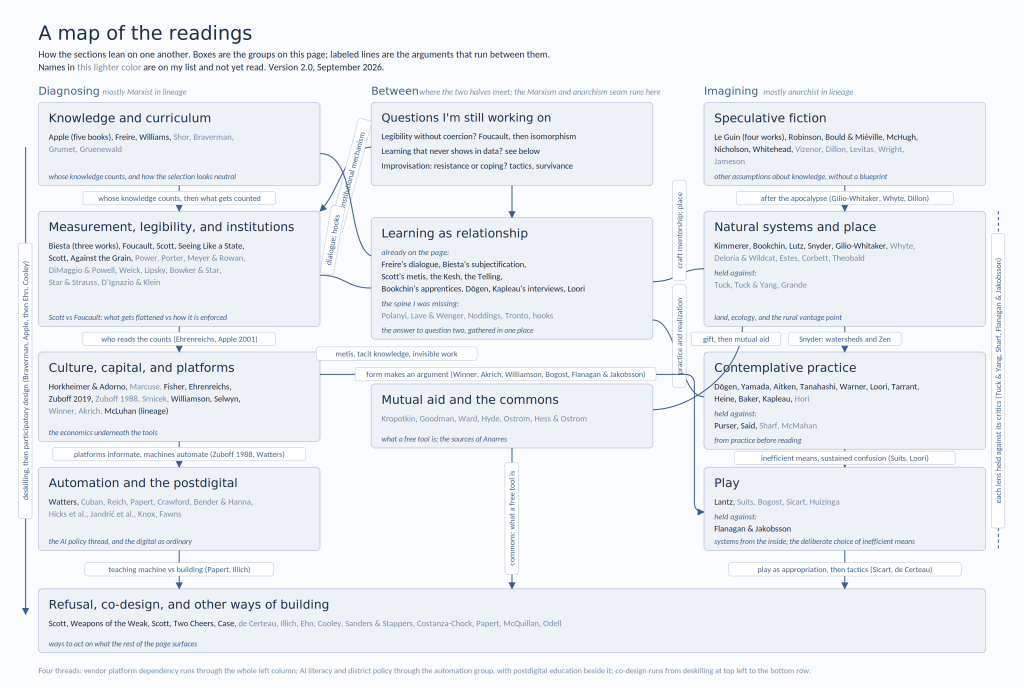
A few conventions. The page includes works I have not read yet. Entries marked On my list describe what I understand a work to argue, from reviews, citations in other books, or conversations, and why I think it belongs here. I have tried to keep those descriptions honest about being secondhand, and I expect some of them to be wrong in ways I will only discover by reading. When I do read one, the entry gets rewritten from the reading and the changelog says what changed. The map below shows how the sections lean on one another. Most of the connections it draws are ones I only noticed by trying to draw them.
On this page
- Research Interests
- Questions I’m Still Working On
- Readings
- Diagnosing: knowledge and curriculum; measurement, legibility, and institutions; culture, capital, and platforms; automation and the teaching machine; the postdigital
- Between: learning as relationship
- Imagining: speculative fiction; natural systems and place; contemplative practice; play; mutual aid and the commons; refusal, co-design, and other ways of building
- Changelog
Research Interests
Most of my work happens with rural districts across South Dakota and Wyoming, and that vantage point shapes what I notice about educational technology. Every platform carries assumptions about how much staff time and training a district can give it. In a large, well-resourced system those assumptions stay mostly invisible, because there is enough slack to absorb them. In a small district where the person managing technology also teaches or coordinates testing, the assumptions show up quickly, usually as the part that doesn’t fit.
The districts that feel those assumptions most sharply also tend to end up the most dependent on vendors. They have the least capacity to build or maintain alternatives, so they adopt what is offered through the state or a consortium, and leaving later costs far more in retraining and lost records than the original license did. My doctoral research looks at that vendor platform dependency directly, and at why it tends to be structural rather than the result of any single purchasing decision.
That said, rural educators are not only on the receiving end. They improvise constantly, working around tools that don’t fit and building local practices the platform never records. That improvisation is part of why I don’t think critique is enough on its own, and it is why my reading moves in two directions.
The first set of readings helps me diagnose. Critical curriculum theory from Michael Apple and Raymond Williams, along with Paulo Freire’s critique of banking education, explains how school knowledge gets selected and made to look neutral. Gert Biesta and Michel Foucault on measurement, James C. Scott on legibility, Audrey Watters on the long history of automated teaching, and writers on platforms and data such as Ben Williamson and Neil Selwyn help me see how defaults, required fields, and reporting structures come to operate as a theory of learning that rarely gets argued for out loud. The second set helps me imagine something else. Speculative fiction, natural systems, contemplative practice, and play are the lenses I use to look for other ways learning could be organized. None of those sources were written about course design or district technology, so when I apply them I am borrowing, and I try to say so.
Putting the map together made me notice a seam I had been straddling rather than naming. The diagnosing side is mostly Marxist in lineage: Apple through Gramsci and Williams, Fisher, and the Frankfurt School behind Marcuse. The imagining side leans anarchist: Scott’s two cheers, Bookchin’s social ecology, Le Guin’s Anarres, Kimmerer’s gift economy, and Kropotkin somewhere underneath all of it. Those traditions disagree with each other about where problems come from and where answers are likely to be found, and Bookchin’s late polemic against Marxism sits on this page a few groups away from Marcuse. I don’t think I have to resolve that, but I should say that it’s there. My own practice sits in the middle, building free tools inside a state-funded cooperative that administers a vendor platform, and most of what I write comes from that middle.
A second thing the map made visible is a mismatch in tempo. Williams’s selective tradition works over generations and Scott’s grain thesis over millennia. Educational technology moves fast enough that a full cycle of adoption, dependency, and replacement can run inside one administrator’s tenure. Watters is the diagnosing source that matches education’s actual pace, which is part of why she has been doing more work across my thinking than her single entry suggests. It may also be part of why dependency is structural: the cycle runs faster than any small institution’s capacity to evaluate it.
Four threads run through that frame, and I have tried in this version to give each of them readings rather than just a name. Vendor platform dependency is the center of the doctoral work, and it draws on the knowledge and curriculum group, the measurement group, and the platform group below. AI literacy and district AI policy raise many of the same dependency questions on a shorter timeline, since districts are often adopting tools and writing guidance for them in the same year, and the automation group is where I am building that thread’s foundation. Postdigital education is useful to me because it stops treating the digital as a category separate from ordinary schooling, and it now has a short group of its own. Co-design in learning technology is where the imagining side gets practical, because it asks who gets to shape a tool before it arrives in a classroom, and I have learned that its history is more tied to the diagnosing side than I realized: participatory design began as a response to the deskilling Apple writes about.
Questions I’m Still Working On
What does legibility look like without a state’s coercion? Scott’s states could conscript and relocate people, and a platform vendor can do none of that. In education the pressure travels through procurement, dependency, default settings, and reporting requirements that flow down from departments of education, accreditors, and funders, with platforms serving as the infrastructure those bodies read through. The pattern Scott describes looks familiar to me, but I want a clearer account of that mechanism before leaning on his framework harder.
Working on the map pushed me toward part of an answer that was already on the page. Scott and Foucault do not actually agree about where power sits. Scott’s legibility is a view from the center, a state that needs to see and simplify in order to govern. Foucault’s discipline needs no center at all, because normalizing judgment and the examination work through the routines of the institution, and the people being examined come to examine themselves. A platform does not need to conscript anyone. It sets a norm, makes small constant judgments against it, and produces cases. The reason the question still feels open is that I have been asking Scott to explain how the flattening is enforced, which is Foucault’s job, when Scott’s job is to name what gets flattened. What neither of them explains is why a small district adopts the consortium’s platform in the first place, and for that I have started reading toward institutional theory, which has a name for it (isomorphism) and a name for the gap between what the platform reports and what teachers actually do (decoupling). Those entries are in the measurement and institutions group below.
How do I account for learning that never shows up in data? Scott argues that early states depended on grain partly because it ripens visibly and on a schedule, which makes it easy to assess, while tubers can stay underground and out of sight. Reporting systems favor learning that ripens the way grain does. The question a teacher acts on eight months later, or a conversation in a hallway, doesn’t register anywhere. Scott was writing about crops and states, so the comparison is mine.
When I wrote the first version of this page I said the comparison rested on Scott and a few speculative sources more than on a developed account of that kind of learning. That turned out to be only half true. The account was on the page, but scattered across five sections and filed as borrowings: metis in Scott, dialogue in Freire, subjectification in Biesta, learning as relationship among the Kesh, the Telling that can only be learned by entering it, craft mentorship in Bookchin, practice and realization in Dōgen, the interview transcripts in Kapleau, sustained confusion in koan work. Each makes the same claim from a different tradition, that the learning that matters most happens in relationship, over time, in the body, and cannot be pulled out as a record without changing what it is. What the cluster lacked was a spine a committee would recognize, and several of the candidates are not borrowings at all. Lave and Wenger studied apprenticeships. Noddings wrote about schools. Polanyi is epistemology. The feminist sociology of invisible work is about exactly the hallway conversation. I have gathered all of that into a new section between diagnosing and imagining, and I expect it to keep growing.
Is rural improvisation resistance, or just coping? Some of what rural educators do with ill-fitting tools resembles Scott’s everyday resistance, where small and deniable acts add up over time. Some of it may simply be how people get through an underfunded system, and praising it risks treating the underfunding as acceptable. Scott’s subjects also faced far higher stakes than a teacher working around an LMS. I haven’t settled how to tell resistance from coping, and I have started to suspect the either-or is the problem. Gerald Vizenor’s idea of survivance, which Grace Dillon draws on in Love Beyond Body, Space, and Time, describes an active presence and a continuance of stories rather than a mere reaction, and it may be a better frame than either of my two options. It comes out of Native experience specifically, though, so carrying it over to rural schools would need the same care as the other Indigenous sources on this page.
Two other sources on my list may dissolve the question rather than answer it. De Certeau’s distinction between strategies and tactics treats making do inside someone else’s system as its own category, creative rather than merely reactive, and Lipsky’s work on street-level bureaucracy treats frontline discretion under scarcity as simply how underresourced institutions run, protective or harmful depending on what it’s used for. Eve Tuck’s argument against damage-centered research names the risk I was circling, that documenting what people do to get by can fix them as damaged. And Michael Corbett’s ethnography of a rural fishing community, where schooling credentialed the knowledge that let people leave and ignored the knowledge that let them stay, is Scott’s grain and tuber argument applied to rural schooling with data behind it. Those entries are in the refusal group and the natural systems group.
Readings
Select any title to open my notes on it. Most entries cover what the work argues, how I use it, and where my application of it strains. Entries marked On my list are works I have not read yet; those cover what I understand the work to argue and why I want to read it, and I have tried to be clear that the understanding is secondhand. The readings are split by what they mostly do for me, though several could sit on either side. Beyond the books below, I also keep returning to the work of Jesse Stommel and Maha Bali.
Diagnosing
Knowledge and curriculum
This is where the diagnosing starts, with the question of whose knowledge ends up counting and how that choice comes to look neutral. Apple, Freire, and Williams were writing about textbooks, classrooms, and cultural tradition, and I extend them to platforms, where defaults and reporting structures now do much of the selecting. Two of the entries on my list here are about labor, because Apple’s argument about deskilling has a source and a gendered dimension that both tend to drop out when I cite him.
Michael W. Apple, Ideology and Curriculum (1979)
Apple argues that school knowledge is a selection that reflects and reproduces existing relations of power, and that its appearance of neutrality is what gives it force. His reframing of Herbert Spencer’s old question, from what knowledge is of most worth to whose knowledge, is the question I bring to platform defaults and reporting structures, which I read as curriculum decisions made somewhere other than the classroom. His chapter on systems management, where efficiency language turns political questions into technical ones, helps me explain what the label “research-based” often does. Apple was writing mainly about class and economic reproduction before data infrastructure existed, so extending him to platform vendors is my move, and it needs saying.
Michael W. Apple, Education and Power (1982)
Here Apple develops the idea of technical control, which moves out of direct supervision and into materials and procedures, so that a teacher following a prepackaged curriculum is managed by it without anyone else in the room. He ties this to deskilling, the separation of planning a job from carrying it out. Technical control is the main lens in my research on vendor platform dependency, and it helps me see how a dashboard can shape what counts without telling anyone what to value. Apple’s argument concerns teachers’ labor and curriculum materials, so applying it to LMS configuration is analogy. His frame also doesn’t anticipate practitioners building their own tools, which is part of why the co-design entries at the end of this page matter to me.
Michael W. Apple, Teachers and Texts (1986)
This is where Apple develops intensification: teachers’ work steadily expands while time and resources shrink, and a workforce with no slack cannot evaluate the tools and curricula handed to it. The book also treats textbooks as commodities and reads the gendering of teaching as central to how deskilling gets accepted. I lean on intensification when AI tools promise to give teachers time back, since that promise treats the intensified condition as permanent and offers a technical offset. The gender analysis is central to Apple’s argument, and it tends to disappear when the book is cited only for intensification, including when I cite it. The Grumet entry below is my attempt to stop doing that.
Michael W. Apple, Official Knowledge (1993)
Apple asks what counts as official knowledge, meaning knowledge sponsored by the state, the textbook industry, and the school, and who benefits from its official status. He works through the conservative politics of the 1980s and the economics of textbook adoption, and asks when counter-hegemonic work in schools is possible. I use it when the question is legitimation, meaning why a platform’s defaults come to feel like the official way learning works. Apple’s official knowledge is sponsored by the state and publishers, while platform defaults are sponsored by vendors and adopted by institutions, which is a related but different path to legitimacy.
Michael W. Apple, Educating the “Right” Way (2001)
Apple analyzes the coalition that reshaped American education from the 1980s on, made up of neoliberals, neoconservatives, authoritarian religious populists, and a fraction of the professional and managerial middle class whose careers depend on accountability and measurement. That last group is easy to miss because its commitment is to the tools of assessment rather than to any particular end, which lets its expertise serve almost any political project. I use it as the historical anchor for thinking about the people whose standing now comes from reading platform analytics. Apple’s coalition belongs to its American moment and was built around testing and standards, so the move to platform data is an extension. The class that fraction belongs to was named by Barbara and John Ehrenreich in their 1977 essay on the professional-managerial class, which used to have its own entry here. The term has since become an online insult, and the Ehrenreichs include teachers in the class, which complicates any argument that sets teachers against it, so Apple’s narrower distinction does the work and I now cite the essay only as lineage.
Paulo Freire, Pedagogy of the Oppressed (1968; English 1970)
Freire’s central diagnosis is the banking concept of education, where teachers deposit content into passive students, which he sets against problem-posing education in which teachers and students investigate reality together through dialogue. Underneath is a theory of oppression and of critical consciousness developed through reflection and action. I mostly use the banking critique, for courses built as content dumps and for professional development that treats learning as transfer. Freire was writing about the oppressed in a specific Latin American political context, and applying the banking metaphor to an online module risks flattening that political weight. His dialogue is also between people, which no platform can take part in. Freire is also the root of my co-design thread, and the Grande entry in the natural systems group is the Indigenous critique of him that I need to answer before leaning on him for that.
Ira Shor, Empowering Education (1992), and Ira Shor and Paulo Freire, A Pedagogy for Liberation (1987) (on my list)
On my list. I have read Shor in pieces and cited him in conversation for years without sitting down with either book, which is not a good habit. Empowering Education is, as I understand it, Freire’s critical pedagogy worked out for American classrooms, with attention to the practical business of building a dialogic course, and the book with Freire is a set of recorded conversations between the two of them about what liberatory teaching looks like when the teacher is still the one being paid. I want the second for that tension in particular, since it is close to the one I live in, and I want the first because my co-design thread needs an account of dialogic teaching that is about method rather than only about stance.
Raymond Williams, Marxism and Literature (1977)
Williams’s idea of the selective tradition describes how, out of everything available from the past and present, certain meanings and practices get chosen for emphasis while others are neglected, and the selection then gets presented simply as the tradition. The tradition is continually remade, and the remaking serves whoever is dominant. I pair it with Apple to describe how one platform’s way of doing things becomes how online learning is done, while the alternatives are forgotten. Williams was writing about literary and cultural tradition over long historical periods. Platform conventions form in years rather than generations, which may change the mechanism even when the pattern looks similar.
Harry Braverman, Labor and Monopoly Capital (1974) (on my list)
On my list. This is the book Apple borrows deskilling from, and I have been citing the borrowing without reading the source. Braverman’s argument, as far as I understand it, is that scientific management separates the conception of work from its execution so that skill, and the bargaining power that comes with skill, moves from the worker into the process and the machine. That is technical control before Apple applied it to teachers. I want to read it because the participatory design tradition in the last group of this page was built explicitly as a response to Braverman, which means co-design and deskilling are two ends of one argument rather than two of my interests that happen to coexist.
Madeleine Grumet, Bitter Milk: Women and Teaching (1988) (on my list)
On my list. Grumet reads teaching as gendered labor, and from what I have gathered she works through the history of how a profession dominated by women came to be managed by men, and what that has meant for how teachers’ knowledge and care get valued. I want it because the gender analysis in Teachers and Texts keeps dropping out of my own citations, and because the learning that never shows up in data, the hallway conversation and the question a teacher acts on months later, is care work and invisible work, which is a feminist labor problem before it is a measurement problem. Grumet is the education-specific version of that argument; Arlie Hochschild’s The Managed Heart (1983) on emotional labor is the general one, and it is on the list behind her.
David Gruenewald, “The Best of Both Worlds: A Critical Pedagogy of Place” (2003)
Gruenewald, who now publishes as David Greenwood, argues that critical pedagogy and place-based education each lack what the other does well. Critical pedagogy in North America settled into urban social analysis and left out ecology and rural places, an odd turn for a tradition that began with Freire’s work among rural peasants, while place-based education stayed insulated from the conflicts over race and power that critical pedagogy starts from. His synthesis pairs decolonization, learning to recognize disruption and injury and address their causes, with reinhabitation, learning to live well in a place that has been damaged. What I extend is his account of a standardized, “placeless” curriculum, since a platform built to behave the same way in every district is placeless by design. He was writing about standards and testing, so that extension is mine. His insistence that what needs conserving is as critical a question as what needs transforming gives me a better way into my question about rural improvisation, because it asks which local practices a district should protect when a platform arrives. He also borrows David Sobel’s caution that critique delivered before attachment produces hopelessness, which I should hold my own writing on vendor dependency against. Where my use strains is the ecological half: when I say place I mostly mean the social and institutional conditions of rural districts, and he insists the land is part of it. Robert Stevenson’s response in the 2008 Environmental Education Research reprint issue, which I understand asks what a place is once learning moves to virtual sites, is next on my list, with C. A. Bowers’s reply from the same issue and Paul Theobald’s Teaching the Commons (1997) behind it.
Measurement, legibility, and institutions
These readings are about what happens to learning once it has to be counted. Biesta asks what measurement crowds out of the question of what education is for, while Foucault and Scott look at what constant assessment and simplification do to the people and places being made readable. Most of what I write about dashboards and reporting leans on this group. It is also where I am reading toward a level that was missing from the first version of this page, the organization, since neither the state nor the individual is where a district decides to adopt a platform.
Gert Biesta, “Why ‘What Works’ Won’t Work” (2007)
Biesta critiques evidence-based practice as it was imported into education from medicine. Education is a relationship between agents rather than a causal intervention on a patient, evidence about effectiveness can only speak to means, and treating “what works” as the governing question removes the ends of education from democratic discussion. That argument underlies my writing on why research-based is not a purpose. Biesta is often read as anti-research, which he isn’t, since his argument concerns the relationship between research and judgment, and I try to keep that intact. The essay also responds to a 2000s policy moment that predates the current federal evidence tiers.
Gert Biesta, Good Education in an Age of Measurement (2010)
Biesta argues that the international culture of measuring and comparing outcomes has displaced the question of what education is for. He proposes that good education works in three overlapping and sometimes conflicting domains: qualification, socialization, and subjectification, which means becoming someone who can act and judge independently. He also names learnification, the displacement of the language of education by the language of learning, which lets harder questions about content, purpose, and relationship go unasked. I use the three domains to show how most research-based claims concern a thin slice of qualification. The scheme can harden into a checklist, which is exactly the managerial move Biesta argues against, and my own work is full of the “learning” language he questions.
Gert Biesta, “Education, Accountability, and the Ethical Demand” (2004)
Biesta separates two meanings of accountability: an older relational sense of being answerable to others, and the technical-managerial sense of audit and output monitoring that now dominates. He argues the managerial sense turns professional relationships into contractual and consumer ones, and shifts control from regulating what teachers may do to monitoring what results they produce, which is more effective and less visible. I use that distinction when looking at how reporting requirements work as control, including when mapping who actually makes decisions in a district versus who is supposed to. I haven’t yet found a clear place where the application strains, though the Power entry below may turn out to be the fuller version of the argument.
Michel Foucault, Discipline and Punish (1975; English 1977)
Foucault traces how modern power shifted from spectacular punishment to disciplinary techniques that produce docile, useful individuals. The section I return to describes hierarchical observation, normalizing judgment, and the examination, which turns individuals into cases that can be described, measured, and compared, with schools as a central example. I use normalizing judgment to describe how constant small assessments on a platform shape a particular kind of learner. Foucault is easy to misuse as a general warning about surveillance. His argument concerns how power produces people rather than privacy, so when the point is only that platforms collect data, plainer description does the job better. He also does not agree with Scott about where power sits, and I had been reading them as if he did. Foucault’s discipline needs no center and no coercer, which makes him the better source for how a platform’s norms get enforced, while Scott remains the better source for what gets flattened in the process.
James C. Scott, Seeing Like a State (1998)
Scott explains why large schemes of social engineering fail. States need to simplify what they govern so it can be seen, measured, and taxed from the center, and that narrowing discards the local practical knowledge, which he calls metis, that made the complex system work. Scott is explicit that market standardization does this too. Legibility is my main lens for LMS data and assessment, where learning gets redesigned to be visible to reporting, and metis underwrites my defense of teacher craft against templates. Scott’s states had coercive power that vendors lack, so in education the mechanism runs through procurement, defaults, and reporting requirements, and the institutional entries below are where I am looking for that mechanism. Scott is also no defender of markets, and I try not to drift toward that reading.
James C. Scott, Against the Grain (2017)
This is Scott’s revisionist history of the earliest states. He argues that settled agriculture long preceded states, that early states were fragile and often unwelcome, and that grain suited them because it ripens visibly, all at once, and on a schedule that can be assessed and taxed. I use the grain argument to think about learning that has been bred to ripen visibly for the assessment apparatus, and about the illegible learning that doesn’t. Historians have pushed back on whether early states required crop simplification, and have noted that many taxed labor rather than grain. The labor objection actually sharpens my version, since seat time and attendance hours are what institutions tax when learning itself stays illegible.
Michael Power, The Audit Society: Rituals of Verification (1997) (on my list)
On my list. Power’s argument, as I understand it from how often it gets cited near Biesta, is that auditing spread from finance into every kind of institution as a way of manufacturing trust where trust was missing, and that audit reshapes whatever it audits, because organizations reorganize themselves to be auditable. That is the reporting requirement described as a mechanism rather than a metaphor, and it would sit between Biesta’s managerial accountability and Scott’s legibility. I want it alongside Theodore Porter’s Trust in Numbers (1995), which I understand argues that quantification is what institutions reach for when they lack the authority to be trusted on judgment. Together they might explain why a small district trusts a dashboard over a teacher: not because anyone believes the dashboard more, but because the dashboard can be shown to someone else.
John W. Meyer and Brian Rowan, “Institutionalized Organizations: Formal Structure as Myth and Ceremony” (1977), and Paul J. DiMaggio and Walter W. Powell, “The Iron Cage Revisited” (1983) (on my list)
On my list. These are the two founding articles of institutional theory in sociology, and they may be the mechanism my first open question has been asking for. Meyer and Rowan argue that organizations adopt formal structures for legitimacy rather than efficiency and then quietly decouple those structures from what actually happens inside. DiMaggio and Powell name three ways organizations come to resemble one another: coercive, when a funder or regulator requires it; mimetic, when an uncertain organization copies one that looks successful; and normative, when professional training spreads a practice. A rural district adopting the consortium’s platform because everyone else did is mimetic isomorphism, and the gap between what the platform reports and what teachers actually do is decoupling. I have been describing both of those things without names for years. Karl Weick’s “Educational Organizations as Loosely Coupled Systems” (1976) is the education-specific companion and is on the list with them.
Michael Lipsky, Street-Level Bureaucracy (1980) (on my list)
On my list. Lipsky’s argument, as I understand it, is that frontline public workers under conditions of scarcity exercise discretion constantly, and that their discretion is the policy as it actually gets delivered, whatever the policy says on paper. Teachers are among his central cases. I want it because it is an unromantic answer to my question about rural improvisation. Discretion under scarcity is neither resistance nor coping in Lipsky’s account; it is how underresourced institutions run, and it can protect people or harm them depending on what it gets used for. That is a more honest starting point than either of the two options I was choosing between.
Geoffrey C. Bowker and Susan Leigh Star, Sorting Things Out: Classification and Its Consequences (1999), and Susan Leigh Star and Anselm Strauss, “Layers of Silence, Arenas of Voice: The Ecology of Visible and Invisible Work” (1999) (on my list)
On my list. Star’s work is where the legibility thread and the labor thread meet. Sorting Things Out, as I understand it, treats classification systems as infrastructure that becomes invisible once it works, and shows what happens to whatever the categories cannot hold. The article with Strauss is a short, foundational piece about what changes when work is made visible to a system and when it is not, and it comes out of the same feminist sociology as Grumet and Hochschild above. Together they would let me connect Williamson’s data infrastructures to the tuber problem through a concept, invisible work, that already has a literature behind it. A required field in an LMS is a classification decision, and Star is the person who studied what those decisions do.
Catherine D’Ignazio and Lauren F. Klein, Data Feminism (2020) (on my list)
On my list. This is the one book on this page that tries to answer the question I usually stop at, which is how we should count, then. From what I have read about it, D’Ignazio and Klein build a constructive program for data work that starts from what gets left out, with a chapter organized around the idea that what gets counted counts. I want it because everything else in this group is diagnosis, and because it connects Williamson and Foucault to the invisible-work entries above and to the refusal group at the end of the page. It is also, I suspect, the source I would hand a colleague who wanted to build better reports rather than fewer of them.
Culture, capital, and platforms
This group looks at the economics underneath the tools, from how a manufactured way of life comes to feel natural to what platforms do with the data they collect. Several of these writers were not writing about education at all, so this is where I have to be most careful about naming analogy as analogy, especially with Fisher and Zuboff. The entries on my list here are mostly repairs: a better Zuboff for the enterprise case, the mid-century step between the Frankfurt School and Fisher that I had been skipping, and two sources, Winner and Akrich, that make the claim about form and artifacts I had been hanging on McLuhan. Three entries that were only carrying lineage, McLuhan, the culture industry chapter, and the Ehrenreichs, have been folded into the entries that use them.
Herbert Marcuse, One-Dimensional Man (1964) (on my list)
On my list. Marcuse is the mid-century step between the Frankfurt School’s culture industry and capitalist realism that I had been skipping over. Horkheimer and Adorno’s culture industry chapter from Dialectic of Enlightenment (1944; revised 1947) used to have its own entry here. It argues that culture produced on industrial lines standardizes what people experience while presenting that sameness as variety and choice, and I read it alongside Fisher as an earlier account of how a manufactured way of life comes to feel natural, but it was built on the film and radio industries of the 1940s and needs real updating before it says much about platforms. Marcuse’s argument, as I understand it, is that technological rationality closes the universe of discourse, so that alternatives to the existing order become not forbidden but literally unthinkable, and that this closure is accomplished by technology and administration rather than by force. That is Fisher’s atmosphere forty-five years earlier and with technology at the center of it, which is why it belongs on this page and the Adorno chapter no longer does. It also seems to be a cousin of Illich’s radical monopoly, in the last group, and I want to read the two of them close together.
Mark Fisher, Capitalist Realism (2009)
Fisher argues that after 1989 capitalism came to seem like the only realistic system, to the point where alternatives are hard even to imagine. Capitalist realism is less a belief than an atmosphere, and Fisher draws examples from his own teaching in British further education, including audit culture and the privatization of stress. He also names business ontology, the assumption that everything, education included, should be run as a business. I borrow the frame for teaching realism, my term for how teacher burnout gets treated as permanent and then offered technological fixes. Fisher’s concept is specifically about capitalism, so I use a separate term rather than stretch his, and his audit regime is British rather than American.
Shoshana Zuboff, In the Age of the Smart Machine: The Future of Work and Power (1988) (on my list), and The Age of Surveillance Capitalism (2019)
The 2019 book is the one I have read. It argues that a new economic logic, pioneered by Google, treats human experience as free raw material for behavioral data, much of which gets turned into predictions sold to businesses that want to know and shape what people will do, so that users are the source of that surplus rather than the customers. Her argument is about commercial behavioral markets, and an enterprise-licensed LMS sells to institutions rather than advertisers, so applying her to school platforms is analogy that has to be grounded in what specific vendors actually do with data, and I use her narrowly. I have come to think I have been reading the wrong Zuboff for my purposes. The 1988 book, still on my list, is about workplace computerization rather than consumer surveillance, which is the enterprise case I actually work in. As I understand it, she distinguishes technology that automates work from technology that “informates” it, meaning that it renders work visible as data as a side effect of doing it, and she describes the workplace panopticon that managers tend to build once work has been informated. An LMS informates teaching. That framing would connect to Apple’s technical control and to Foucault far more cleanly than the 2019 book does, and once I have read it the earlier book should carry this entry.
Nick Srnicek, Platform Capitalism (2017) (on my list)
On my list. A short book that I understand to give a precise definition of the platform as an economic form: an intermediary that hosts interactions between parties and extracts data and rent from hosting them. This group has been missing a political economy of platforms specifically, as opposed to a political economy of culture or of surveillance, and Srnicek is the standard one. Williamson’s more recent work on rentiership in education builds on him, so reading Srnicek would also let me follow that argument at its source.
Ben Williamson, Big Data in Education (2017)
Williamson traces how data infrastructures have become a governing layer in education, following the commercial and philanthropic actors who build learning analytics and the policy that reads their outputs. His argument is that data systems don’t just measure education but reshape it, by encoding theories of learning and governance into software. I use him to support the claim that analytics vendors and the people who read their dashboards shape what counts as good teaching as much as elected or hired decision-makers do. Williamson works at national and international scale, while my work is with districts and a regional service agency, so the mechanism transfers more readily than the examples.
Neil Selwyn, Is Technology Good for Education? (2016)
Selwyn makes an accessible case that technology is neither neutral nor inherently improving, and that the dominant stories about educational technology serve commercial and political interests that deserve examination. His later Should Robots Replace Teachers? (2019) extends the argument to automation. I haven’t leaned on Selwyn much in published work yet, but he is useful when Apple and Scott are too heavy for a general audience. I haven’t run into a strain with him so far.
Langdon Winner, “Do Artifacts Have Politics?” (1980), and Madeleine Akrich, “The De-scription of Technical Objects” (1992) (on my list)
On my list. Winner argues that some technologies settle political questions in their design, with Robert Moses’s low overpasses as the case everyone cites. Akrich, working in the science and technology studies tradition, introduces the idea of a script: designers inscribe a picture of the user and the world into an artifact, and the artifact then prescribes behavior back to whoever uses it. “A required field embeds a theory of the learner” is a script in exactly her sense, and I have been making that claim for years without the term. I am a little embarrassed not to have read either, since they are short and every platform argument I make rests on them. These two also let me retire McLuhan to lineage. Understanding Media (1964) used to have its own entry here, because its core move, the idea that a medium’s form makes an argument regardless of the messages passing through it, is behind my claim that platforms carry theories of learning through defaults, required fields, and reporting structures. He was the weakest source for it. Williamson makes the claim about data systems, Flanagan and Jakobsson make it about game rules, and Winner and Akrich make it about artifacts in general, and McLuhan’s hot and cool media and his electric age are dated enough that I would rather show a platform’s form making its argument and then note where the sensibility came from.
Automation and the teaching machine
Watters had been sitting in the platform group above doing more work than her placement suggested, since she is the source I reach for whenever an AI product presents itself as new. This group gathers her with the readings I am building toward for the AI literacy and district policy thread, which in the first version of this page was a name with nothing underneath it. The largest gap here turned out to be the alternative to the teaching machine rather than another critique of it.
Audrey Watters, Teaching Machines (2021)
Watters tells the history of teaching machines in the United States from the 1920s through the 1960s, following figures such as Sidney Pressey and B. F. Skinner, and shows that the promise of personalized, automated instruction is far older than computers and closely tied to behaviorism and to business. It has shaped how I read current claims about AI tutoring and personalized learning, which tend to present themselves as new. It is a history of an earlier technology in one country, so connecting it to today’s AI tools is my extension rather than her claim. Watters also closes the book by setting Skinner against Seymour Papert, which is the door to the entry two below.
Larry Cuban, Teachers and Machines (1986) and Oversold and Underused (2001) (on my list)
On my list. Cuban is the empirical historian to Watters’s narrative one. As I understand him, Teachers and Machines traces film, radio, and television through American classrooms and finds the same cycle each time: enthusiasm, purchase, marginal use, blame on teachers. Oversold and Underused does the same for computers in Silicon Valley schools and argues that the constraints of schooling itself, not teacher resistance, explain the low use. That is intensification and rural capacity described from the outside, and the cycle he describes runs at the tempo I was worried my other sources miss. Justin Reich’s Failure to Disrupt (2020) is the accessible recent version and sits with him on the list.
Seymour Papert, Mindstorms (1980) (on my list)
On my list. Papert’s phrase, as it gets quoted, is that the child should program the computer rather than the computer programming the child, and his constructionism holds that people learn best by building things they care about that others can see. I build tools, teach educators to build tools, and have written a whole page about vibe coding, and there has been no constructionist source anywhere on this page. Papert is the alternative to the teaching machine, and Watters uses him that way. He also connects to Illich in the last group, since both were arguing in the same years for tools that extend the user’s capacity rather than replace it.
Kate Crawford, Atlas of AI (2021) (on my list)
On my list. I have compared generative AI to plastic waste in my own writing without a source for the material side of that comparison. Crawford’s book, as I understand it, follows AI through minerals, labor, energy, data, and state power and argues that it is an extractive industry before it is anything else. That is the account I need when I try to say what a tool costs beyond the people using it, including its lifespan and its energy use, and it is the account a district AI policy should have somewhere behind it.
Emily M. Bender and Alex Hanna, The AI Con (2025), and Michael Townsen Hicks, James Humphries, and Joe Slater, “ChatGPT Is Bullshit” (2024) (on my list)
On my list. I have been using the word bullshit about language model output in Harry Frankfurt’s sense, text produced without regard to truth, and the Hicks article is where that argument is made carefully, so I should read it rather than only agree with it. Bender and Hanna’s book is, from what I gather, the accessible critical statement from the linguist behind the stochastic parrots paper, and it is probably the one I would hand an administrator. Dan McQuillan’s Resisting AI (2022) belongs to this thread as well, but it argues for refusal and for workers’ councils over ethics frameworks, so I have put it in the last group where that argument lives.
The postdigital
This is the shortest group, and in the first version of this page it did not exist, even though I named postdigital education as one of my four threads. The thread matters to me because it stops treating the digital as a separate category from ordinary schooling, and the rural districts I work with are the clearest case: the digital is not an add-on there, it is the substitute teacher, the state reporting system, and the library.
Petar Jandrić, Jeremy Knox, Tina Besley, Thomas Ryberg, Juha Suoranta, and Sarah Hayes, “Postdigital Science and Education” (2018), and Jeremy Knox, “What Does the ‘Postdigital’ Mean for Education?” (2019) (on my list)
On my list. The first is the founding statement of the field and the second is the clearest short account of it that I have seen cited. As I understand the position, the postdigital is not what comes after the digital but the condition in which the digital has become so ordinary that separating it out no longer describes anything, so that asking whether technology is good for education is already the wrong shape of question. Selwyn and Williamson both publish in this space, which should make it easy to connect to what I already read.
Tim Fawns, “An Entangled Pedagogy: Looking Beyond the Pedagogy–Technology Dichotomy” (2022) (on my list)
On my list. Fawns argues, from what I have read of the argument secondhand, that both the technology-first and the pedagogy-first framings of teaching with tools are wrong, because pedagogy and technology are entangled with purposes, values, and context and cannot be ordered. That is close to a position I hold without having stated it well, and I want to read it partly to find out whether it is actually mine.
Between: learning as relationship
This section is new, and it exists because of my second open question. When I tried to map where the account of illegible learning lived on this page, it turned out to be everywhere and nowhere: metis in Scott, dialogue in Freire, subjectification in Biesta, the Kesh, the Telling, Bookchin’s apprentices, Dōgen’s practice-realization, Kapleau’s interview transcripts, and the koan student’s long confusion. Each of those entries stays where it was. What this section holds is the spine, the sources that make the same claim as learning theory or philosophy rather than as fiction or religious practice, so that when I argue that the learning that matters most happens in relationship and cannot be pulled out as a record without changing it, I am not only citing novels.
Michael Polanyi, The Tacit Dimension (1966) (on my list)
On my list. Polanyi’s sentence, “we know more than we can tell,” gets quoted everywhere, including by Scott, and I have never read the short book it comes from. His argument, as I understand it, is that skilled knowledge cannot be fully articulated even by the person who has it, and that this is a property of knowing rather than a failure of description. That would give the tuber problem an epistemological floor. If some learning is tacit by nature, then a reporting system that cannot see it is not failing to measure; it is measuring the wrong kind of thing, and no better instrument would fix that.
Jean Lave and Etienne Wenger, Situated Learning: Legitimate Peripheral Participation (1991) (on my list)
On my list. I know this book the way most people in my field do, through the phrase “community of practice,” and I have not read the argument the phrase was cut from. Lave and Wenger studied apprenticeships, among tailors and midwives and others, and describe learning as movement from the edge of a community toward its center rather than as transfer of content into a head. That is the scholarly version of what Bookchin describes in the trades, what Le Guin describes among the Kesh, and what Kapleau shows in the interview room, and unlike those it is learning theory rather than a borrowing. Lave’s earlier Cognition in Practice (1988) sits behind it on the list.
Nel Noddings, Caring: A Feminine Approach to Ethics and Moral Education (1984) and The Challenge to Care in Schools (1992) (on my list)
On my list. Noddings is the relational account of teaching that this page keeps reaching for through fiction and Zen, and she was writing about American schools. As I understand her, she treats the caring relation, the one between a particular teacher and a particular student, as the unit of education, prior to any content, and she argues that schools organized around subjects rather than around care have the order backward. Biesta’s relational accountability and Bookchin’s mentorship both point here. Joan Tronto’s Moral Boundaries (1993), which I understand argues that care is work that gets systematically made invisible, is the political companion and connects back to the Star and Grumet entries above.
bell hooks, Teaching to Transgress (1994) (on my list)
On my list. I have read hooks in excerpts for years and have never given this book a straight read, which is strange, because from what I know of it she is the one writer who joins the three things I keep trying to hold together. Her engaged pedagogy comes out of Freire and out of Thich Nhat Hanh; she insists on the teacher’s own well-being and embodiment as part of teaching rather than separate from it; and she writes about classrooms as communities where the teacher is also at risk. That is critical pedagogy, contemplative practice, and care in one source. She is the missing bridge between the Freire entry and the whole contemplative section, and I suspect she will end up cited more than most of what is already here.
Imagining
Speculative fiction
These books imagine people living under different assumptions about knowledge and community, and several of them, especially the Indigenous anthologies, start from the premise that a world has already ended. They are most useful to me when they refuse to settle into a blueprint, which is the same caution Le Guin builds into The Dispossessed. The entries on my list here are about that caution: two accounts of what utopian thinking is for if not a blueprint, and the two Indigenous sources I had been citing secondhand. The Indigenous entries in this group fall under the same borrowing the natural systems intro below spells out once.
Ursula K. Le Guin, “The Carrier Bag Theory of Fiction” (1986)
Le Guin proposes that the first human tool was more likely a container than a spear, and that narrative has been bent into the shape of the hero’s hunt, linear and driven by conflict. A story can instead work like a bag or bundle that holds things in relation to one another. I keep a small independent edition with a longer introduction and follow-up. My earliest writing on speculative fiction applied the idea to learning design, favoring non-linear paths and environments for gathering and connecting knowledge, and it matters to me because so much teaching has always happened through stories. The essay is about narrative form, so the application to course design is mine.
Ursula K. Le Guin, The Dispossessed (1974)
Shevek, a physicist, travels from Anarres, a poor anarchist moon, to Urras, the wealthy world his people left. The novel shows Anarres as honest, mutual, and free of ownership, and also subject to informal coercion, conformity, and a revolution that has hardened into custom. I use its picture of education, with learning centers, no grades, and chosen work alongside social pressure against standing out, as a lens on autonomy and its limits. The subtitle calls it an ambiguous utopia, and any use has to keep that ambiguity, since Shevek is stifled at home too. The education scenes are brief, so I try not to overclaim what the novel says about teaching. Le Guin named Kropotkin and Paul Goodman among the sources behind Anarres, and both are in the mutual aid group further down. The Marxist reading of the novel I keep coming back to is in Red Planets: Marxism and Science Fiction (2009), the collection Mark Bould and China Miéville edited, which has an essay on utopian art in The Dispossessed and a reading list that has been my way into left speculative fiction beyond Le Guin, including Miéville’s Embassytown and the New Suns anthology edited by Nisi Shawl. It used to have its own entry here, but it is criticism rather than argument, and this is where it does its work.
Ursula K. Le Guin, Always Coming Home (1985)
Le Guin frames the book as an archaeology of the future, a composite portrait of the Kesh, a people living in a far-future Northern California after an ecological catastrophe, assembled from stories, poems, recipes, maps, and songs. At its center is the life of Stone Telling, a Kesh woman who spends years among the patriarchal and militaristic Condor people. Among the Kesh, learning is relational and communal rather than set apart from ordinary life. I return to the Kesh idea that learning is a relationship rather than a transfer, and to the exchanges about what an archive should keep and what it should let go. The book is deliberately unsystematic, so pulling a model of education out of it works against its form, and I try to treat the Kesh material as one voice among many.
Ursula K. Le Guin, The Telling (2000)
Sutty, an observer from the Ekumen, is sent to Aka, where a corporate state has outlawed the old culture and its central practice, the Telling, a vast tradition of stories, histories, and teachings kept alive by ordinary practitioners. She finds that the Telling is less a doctrine than a way of holding a people’s knowledge in relationship, and that she can only learn it by entering into it. I use the novel for the difference between observing a practice and learning it, and as a story version of Scott’s argument about a state erasing illegible knowledge. The Akan regime is close to caricature, so the novel works better for those two points than as an allegory for any particular policy.
Ruth Levitas, Utopia as Method (2013), and Erik Olin Wright, Envisioning Real Utopias (2010) (on my list)
On my list. Both of these address the blueprint anxiety that runs through this whole section, and I keep citing the anxiety without citing anyone who has thought it through. Levitas, as I understand her, argues that utopia is a method of inquiry, an imaginary reconstitution of society that we use to ask what we actually want, rather than a plan for getting there. Wright catalogs institutions that already exist and prefigure something different, cooperatives and participatory budgeting and Wikipedia among them, and calls them real utopias. That second idea lands close to home, since an open tool built inside a public cooperative is a real utopia in his sense, small as it is. Fredric Jameson’s Archaeologies of the Future (2005), which the Bould and Miéville critics draw on, is the longer argument that utopia’s value is as a critique of the present, and it is behind these two on the list.
Maureen F. McHugh, China Mountain Zhang (1992)
McHugh’s first novel is set in a twenty-second century where, after a second Great Depression and a war, the United States has become a satellite state of China. It follows Zhang Zhongshan, a young construction engineer in New York whose heritage and sexuality both put him at odds with his society, through a set of loosely connected stories about other people on the edges of that world, from kite fliers to Mars colonists. What stays with me is its sense that systems are enormous and that people make their lives in the cracks, finding ways to live inside a world they can’t change. That connects to Scott’s everyday resistance and to my open question about rural improvisation. The same quality can read as resignation as easily as survival, which is the tension that question is about, and de Certeau in the last group may be the writer who names what McHugh’s characters are actually doing.
Hope Nicholson, ed., Love Beyond Body, Space, and Time (2016) and Joshua Whitehead, ed., Love After the End (2020)
These are Love Beyond Body, Space, and Time: An Indigenous LGBT Sci-Fi Anthology and Love After the End: An Anthology of Two-Spirit and Indigiqueer Speculative Fiction. Both collections gather speculative fiction by Indigenous writers centering Two-Spirit, queer, and trans characters, with stories ranging from a trans woman undergoing an experimental transition to a Two-Spirit resistance camp. Love Beyond Body, Space, and Time opens with an essay by Grace Dillon on Two-Spirit survivance stories, and Love After the End won a Lambda Literary Award. Several of the writers start from the premise Whyte names in the entry below, that the apocalypse has already happened, which turns the stories toward how people and communities keep going afterward, and Whyte cites Dillon’s essay from the first collection for exactly that reading. These stories were written from and for Two-Spirit and Indigiqueer communities, which is a narrower audience than the rest of the Indigenous cluster on this page addresses, and I read them for that rather than around it.
Kyle Powys Whyte, “Indigenous Science (Fiction) for the Anthropocene: Ancestral Dystopias and Fantasies of Climate Change Crises” (2018)
This article grows out of the 2017 chapter in the natural systems group and keeps its starting claim, that the dread in Anthropocene writing describes a present many Indigenous peoples already inhabit. What it adds is an account of time. Whyte takes the Anishinaabe word aanikoobijigan, which means ancestor and descendant at once, and describes a spiraling temporality in which people live alongside past and future relatives and work out how to act through counterfactual dialogue with them: what would our ancestors make of the situation we are in, and what would our descendants want from us? He is clear that the dialogue does not require causal accuracy, since the ancestors had their own flaws, and that its value is in asking the question well. Two of his answers have stayed with me. Ancestors looking at the present would not, he thinks, mourn lost practices first. They would notice lost qualities: consent, trust, the standing of women, the agency of nonhumans. Descendants, likewise, want those qualities rather than any single tradition kept intact, which frees the dialogue to ask how both old and new practices might carry them. I think that is a better question for platforms than the one I usually ask, which is what practice a tool displaces rather than what qualities it makes harder to have. The second answer is the Menominee forest. Reduced by the U.S. to a reservation fifty times smaller than their homeland, the Menominee designed a sustained-yield forest enterprise in 1856 that the tribe still runs, and Whyte reads it as the product of an earlier generation asking what the forest should mean to people not yet born. It belongs next to Scott’s Weapons of the Weak and de Certeau for me, except that it is not a tactic in de Certeau’s sense. It is a place of one’s own, held for a hundred and seventy years under domination, which is a category neither of those writers gives me. Whyte’s opening question, how do we return the gifts of our ancestors, is Kimmerer’s, and he credits her, so this entry and hers are in conversation whether or not I arrange it. The article closes with a critique of allies who cast themselves as the protagonists who will save Indigenous peoples, and it draws on Tuck and Yang on innocence, which is the argument I am already holding the natural systems lens against. His allies section is also a fair description of the risk in what I am doing with him. Dillon’s Walking the Clouds, which he builds on throughout, is the entry below.
Gerald Vizenor, Manifest Manners (1994), and Grace L. Dillon, ed., Walking the Clouds: An Anthology of Indigenous Science Fiction (2012) (on my list)
On my list. I have been citing survivance through Dillon’s introduction and Indigenous futurism through the anthologies without reading the sources where either was developed. Vizenor coined survivance and, as I understand it, works it out in Manifest Manners as an active presence and a continuance of stories that refuses both victimhood and the settler picture of the vanishing Native. Dillon coined Indigenous futurism in Walking the Clouds and the anthology’s introduction is where the idea that Native peoples already survived an apocalypse gets stated as a literary frame. If survivance is going to be the frame that replaces my resistance-or-coping question, I owe it a direct reading rather than a secondhand one, and both of these are that reading.
Natural systems and place
This lens looks to land and ecology for other ways of organizing things, whether that is Kimmerer’s gift economy or Snyder’s watersheds. It is also where borrowing gets most complicated, because so much of the thinking about living well with land comes out of Indigenous traditions, and the Indigenous entries here and in the speculative fiction group above now number close to ten. None of those writers were writing about course design or district technology, so every use I make of them is a borrowing, and I say that once here rather than at the end of every entry, where it had started to read as a permission slip instead of a check. The cluster is also doing two jobs, and I should be plain about which is which. Deloria and Wildcat on knowledge and place, and Tuck and Yang as the critique the whole lens has to answer, do work for the doctoral argument. Whyte, Gilio-Whitaker, Estes, and Davis and Todd do work for my writing and for the open questions above, which is a legitimate job but a different one. Tuck and Yang is still unread, and it is the reading that decides what in this cluster survives, so it comes before anything else gets added here. Place is in the section title because the rural education sources belong here, and the Lakota and Dakota writers are here because their absence from a page written in Rapid City was hard to justify once I noticed it. The last entries are the critiques I hold this lens against, the way Said and Purser work for contemplative practice.
Robin Wall Kimmerer, The Serviceberry (2024) and Braiding Sweetgrass (2013)
Kimmerer, a botanist and member of the Citizen Potawatomi Nation, writes about the natural world as a system of gifts and reciprocal relationships rather than resources. Braiding Sweetgrass weaves Indigenous knowledge, science, and personal narrative, and The Serviceberry turns the gift economy into a more direct economic argument, using a shrub that shares its abundance as the model. Her point that the market economy is one story among others shapes how I share tools and writing, leading with value, licensing openly, and building capacity rather than dependence. A free tool is not the same kind of gift as a berry, though, and the Hyde and Ostrom entries in the mutual aid group are my attempt to find the political economy that a free tool actually belongs to.
Murray Bookchin, The Limits of the City (1974) and The Ecology of Freedom (1982)
The Limits of the City traces how urban life developed, from towns dominated by the surrounding land to the modern metropolis that dominates the countryside, in order to recover civic traditions Bookchin thought had been forgotten. The Ecology of Freedom lays out his social ecology, the argument that ecological problems grow out of social hierarchy. A short section on mentorship within the trades has stayed with me, because it shows how learning a craft was also a way of being socialized into a community, which connects to Biesta’s socialization domain and to the learning-as-relationship section above. I also draw on his later work, including From Urbanization to Cities, Which Way for the Ecology Movement?, and Anarchism, Marxism, and the Future of the Left. The mentorship material is brief, so I try not to make it carry more weight than it does, and the move from historical trades to modern schools is my analogy.
Gary Snyder, A Place in Space: Ethics, Aesthetics, and Watersheds (1995)
This collection gathers four decades of Snyder’s prose, including the essay “Reinhabitation” and his manifesto “Four Changes.” He uses the watershed, the land drained by a river system, as both a model and a metaphor, imagining communities organized by bioregion rather than by political boundaries and treating human societies as part of nature rather than apart from it. Snyder also trained in Zen in Japan, which makes him one of the few writers on this page who connects natural systems and contemplative practice. He draws heavily on Native American and Asian traditions, and Native writers including Geary Hobson and Leslie Marmon Silko criticized that borrowing, which puts him in the same territory the Said and Purser entries raise and next to Gilio-Whitaker’s history of friction between Native peoples and mainstream environmentalism. Reinhabitation is also one of the two goals in Gruenewald’s critical pedagogy of place, in the knowledge and curriculum group, which takes the term from the same bioregional writing and brings it into education.
Dina Gilio-Whitaker, As Long as Grass Grows (2019)
The full title is As Long as Grass Grows: The Indigenous Fight for Environmental Justice, from Colonization to Standing Rock. Gilio-Whitaker, a citizen of the Colville Confederated Tribes, traces Indigenous resistance to environmental injustice from colonization through the Dakota Access Pipeline protests, and argues that the mainstream environmental justice framework does not fit Indigenous peoples, because it treats injustice as an unequal distribution of harms within a state and leaves out the settler colonialism and the loss of land and sovereignty that produced the harms in the first place. She also writes the history of friction between Native peoples and the environmental movement, from wilderness ideas built on emptied land to the movement’s uneven record at Standing Rock. That history is what I keep from the book. It is the check I hold Snyder against, and its ending at Standing Rock is where Estes, on the list below, begins. In the first two versions of this page I credited her with the idea that Native communities are already living after an apocalypse. The idea is in the book’s air, but the argument is made elsewhere, and now that I have read Whyte the credit has moved to him.
Kyle Powys Whyte, “Our Ancestors’ Dystopia Now: Indigenous Conservation and the Anthropocene” (2017)
Whyte, a Potawatomi philosopher, starts from the dystopian tone of Anthropocene writing, the dread of a future in which species and the stories woven through them are gone, and observes that many Indigenous peoples already live in what their ancestors would have recognized as that future. Settler colonialism in the Great Lakes region reduced the sturgeon to less than one percent of their numbers, halved the wild rice, and polluted the water that anchor Anishinaabe ceremony and story, and it did so at a pace the ancestors would have found impossible to imagine. What I did not expect is that most of the chapter is about three restoration projects, for sturgeon, wild rice, and water, and that each treats conservation as a question of which relationships between people and particular plants and animals to take up again, rather than which species to save or let go, in a period Whyte insists is a brief and disruptive sliver of a much longer history. This is the citation for an idea I had been attributing to Gilio-Whitaker, and reading it firsthand corrected how I use it. The claim is not that a world ended and people endured. It is that the ending is still going on, that the response is a practice of restoring relationships in shared places, and that the public sturgeon release, where settler residents and Anishinaabek put fish back in the river together, is what that practice looks like. Kimmerer, also Potawatomi, is one of the voices he draws on, and the two entries should be read together. The 2018 article that grew out of this chapter, in the speculative fiction group, is where he turns the argument into an account of time.
Heather Davis and Zoe Todd, “On the Importance of a Date, or, Decolonizing the Anthropocene” (2017) (on my list)
On my list. Whyte builds on this article, and it is the source of the image I keep from him: colonialism as a seismic shockwave that has now reached the nations that set it off, which is what Anthropocene anxiety amounts to from where they stand. As I understand it, Davis and Todd argue that the date chosen for the start of the Anthropocene is a political choice, and that dating it to 1610, when the depopulation of the Americas shows up in the geological record, names colonialism as the driver rather than humanity in general. That is what makes Whyte’s ancestors’ dystopia a claim about causation and not only about experience. The article is short, and it belongs next to Estes for the same regional reasons.
Vine Deloria Jr. and Daniel R. Wildcat, Power and Place: Indian Education in America (2001) (on my list)
On my list. Deloria was from Standing Rock, this book is about education, and it is about the relation between knowledge and place in exactly the register I use for this whole lens. I have no good reason for it not being on the first version of this page. As I understand the argument, Deloria and Wildcat hold that knowledge in Indigenous traditions is tied to particular places and to relationships with them, and that American Indian education has to start from that rather than from the abstract and portable knowledge schools prefer. That is the grain-and-tuber argument from the inside of a tradition that never accepted the grain. It is also local to where I work, which matters when so much of this section is borrowed from farther away.
Nick Estes, Our History Is the Future: Standing Rock Versus the Dakota Access Pipeline, and the Long Tradition of Indigenous Resistance (2019) (on my list)
On my list. Estes, from Lower Brule, tells the history of Indigenous resistance in the Northern Plains culminating at Standing Rock, which is where Gilio-Whitaker’s book ends. Reading them together would give me the Lakota historian’s account of the same events alongside the environmental justice frame, and it would ground the post-apocalypse and survivance threads in the region I actually live in rather than in a general Indigenous scholarship. From what I have read about it, Estes is also direct about the role of the Army Corps and the Pick-Sloan dams in the twentieth century, which is the part of South Dakota history that most of the state’s schools do not teach.
Michael Corbett, Learning to Leave: The Irony of Schooling in a Coastal Community (2007) (on my list)
On my list. This is an ethnography of a rural Nova Scotia fishing community, and its argument, as I understand it, is that formal schooling there functioned as an out-migration machine. The knowledge school credentialed was portable and led away; the knowledge that let people stay and make a living was local, tacit, and uncredentialed, and school treated it as absence. That is Scott’s grain and tuber applied to rural schooling with data behind it, and it is the one rural education book I want to read first. Mara Tieken’s Why Rural Schools Matter (2014) and the Biddle and Azano article on the construction of the “rural school problem” are behind it on the list.
Eve Tuck, “Suspending Damage: A Letter to Communities” (2009), and Eve Tuck and K. Wayne Yang, “Decolonization Is Not a Metaphor” (2012) (on my list)
On my list. These two are the critiques I hold this whole lens against, and they are sharper for my purposes than Said, who is about a different geography. Tuck’s letter argues, as I understand it, against damage-centered research, the kind that documents harm to a community in order to make a case for resources and in doing so fixes the community as damaged, and for desire-based research that can hold hope and contradiction together. That names the risk I was circling in my question about rural improvisation. Tuck and Yang argue that using decolonization as a metaphor for other kinds of institutional critique is a settler move that relieves settler discomfort without returning anything. Whether or not I end up agreeing with every part of it, that is the argument this page’s habit of borrowing Indigenous frameworks needs to have answered, and I would rather answer it than avoid it. It is the next thing I read in this group, before anything else gets added to it, because it is the entry that decides whether the borrowing the section intro admits to is defensible or only disclaimed. Sandy Grande’s Red Pedagogy (2004), which I understand to be the Indigenous critique of Freire and critical pedagogy specifically, sits with them, and it matters because Freire anchors my co-design thread.
Contemplative practice
My own practice is koan Zen in the Sanbo Zen (formerly Sanbo Kyodan) and White Plum Asanga traditions, both of which combine Soto practice with the koan curriculum that came down through Harada Daiun and Hakuun Yasutani. That makes this lens different from the others, since it comes from practice before it comes from reading. The books that shaped the practice itself, Kōun Yamada’s Zen: The Authentic Gate, Robert Aitken’s Taking the Path of Zen, Brad Warner’s paraphrases of Dōgen, Kazuaki Tanahashi’s Zen Chants, and Steven Heine on the fox koan, used to have entries here. They sit behind this section rather than in it now, since none of them does work for the research, and what is left is the part of the practice I actually draw on. It also carries its own risk, which is lifting pieces of a religious tradition into design work while leaving the rest behind. The critiques at the end of this section are the ones I try to hold that borrowing against, including the one aimed at my own lineage, since holding the rest of the page to a standard of self-implication and exempting this section from it was not defensible.
Eihei Dōgen, Shōbōgenzō (13th century)
Dōgen, founder of the Japanese Soto school, wrote this collection of essays on practice, time, being, and awakening, and it has a long reputation for difficulty. I keep several translations because each translator makes different choices with a text this dense. What I take from Dōgen is the insistence that practice and realization are not separate, which sits behind my distinction between understanding something intellectually and actually embodying it.
John Daido Loori, ed., Sitting with Koans (2006)
Loori, founder of the Mountains and Rivers Order within the White Plum Asanga and a dharma heir of Taizan Maezumi, gathered scholarly essays and talks by Zen teachers into a collection that moves from the koan’s roots in China through its development in Japan to modern commentary. Koan work asks a student to stay with a question that won’t resolve on intellectual terms, sometimes for a long time, and that tolerance for sustained confusion is something I think learning design usually tries to eliminate too quickly. Bernard Suits, in the play group below, makes what I now think is the same argument from the other direction: play is the deliberate choice of inefficient means.
John Tarrant, Bring Me the Rhinoceros (2004)
Tarrant, Robert Aitken’s first dharma heir and the founder of what became the Pacific Zen Institute, retells fourteen koans and treats them as ways to loosen habits of mind in ordinary life rather than as puzzles to solve. I read it alongside Le Guin’s carrier bag essay, since both treat a story as something that carries understanding rather than delivering a lesson.
Nancy Mujo Baker, Opening to Oneness (2023)
Baker, a teacher in the White Plum Asanga and a dharma successor of Bernie Glassman, offers a practical and philosophical guide to the Zen precepts. She reads each precept at three levels, a literal one, a relative one that takes moral ambiguity seriously, and an ultimate one grounded in nonduality, drawing heavily on Dōgen in the second half of the book. Glassman’s own three tenets, not-knowing, bearing witness, and taking action, come down through the same lineage, and I have started to notice that they are already close to a design stance, which is a thought I want to sit with before I write it up.
Philip Kapleau, The Three Pillars of Zen (1965)
Kapleau built this book with Hakuun Yasutani, founder of the Sanbo Kyodan, including Yasutani’s introductory lectures, verbatim notes from private interviews between teacher and students, and accounts of awakening. It was among the first English-language books to describe Zen training from the inside. The interview transcripts are what I value most, since they show learning happening one on one, in a relationship, over time.
Victor Sōgen Hori, “Teaching and Learning in the Rinzai Zen Monastery” (1994) (on my list)
On my list. Hori trained as a monk in a Rinzai monastery and then wrote about it as a scholar, and this article is, as I understand it, an account of koan training as a pedagogy rather than as a mystical event. What gets cited from it is his description of ritual formalism, learning through the form before any understanding arrives, and the way the monastery deliberately withholds explanation. That is a description of a curriculum that works through sustained confusion, written by someone who went through it and studied it, and it would let me make the claim I make in the Loori entry with something closer to evidence.
Ronald E. Purser, McMindfulness (2019)
The full title is McMindfulness: How Mindfulness Became the New Capitalist Spirituality. Purser argues that mainstream mindfulness has been stripped of the ethical and social context it came from and repackaged as self-help that teaches people to manage their own stress instead of questioning the conditions producing it. It is the critique I bring to contemplative practice in workplaces and schools, and it lines up closely with Fisher on the privatization of stress and with my concern that tools promising teachers relief treat an overloaded job as permanent. Purser is writing about a commercial wellness industry, and not every classroom breathing exercise carries that whole apparatus, so I try to aim him at programs and products rather than at individual teachers.
Edward W. Said, Orientalism (1978)
Said shows how Western scholarship and culture constructed the Orient as exotic, unchanging, and other, and how that representation served Western domination. I use it to question how contemplative practices get framed in contemporary culture, where Buddhist elements get brought out when they add an exotic feel while the rest of the tradition gets left behind. Said’s focus is mainly the Arab and Islamic world and European colonial scholarship, so applying him to Buddhism in the West is an extension.
Robert H. Sharf, “Sanbōkyōdan: Zen and the Way of the New Religions” (1995) and “Buddhist Modernism and the Rhetoric of Meditative Experience” (1995) (on my list)
On my list. This is the entry I least wanted to add. Sharf, a scholar of Chinese and Japanese Buddhism, argues in the first article, as I understand it, that the Harada-Yasutani line I practice in was itself a modern reformulation of Zen, built around lay practice, a compressed koan curriculum, and a rhetoric of personal experience, and that it has a smaller place in Japanese Buddhism than its influence in the West would suggest. The second article makes the broader case that “meditative experience” as Westerners understand it is a modern construction rather than the tradition’s own center. Purser and Said are critiques of what other people do with Buddhism. Sharf is a critique of what my own lineage did with it, and if self-implication is the standard I hold the rest of this page to, then this is the entry the contemplative section was missing. David McMahan’s The Making of Buddhist Modernism (2008) is the book-length version and is behind Sharf on the list.
Play
Play is a lens for thinking about systems from the inside, as something people move through and push against rather than something delivered to them. Playing Oppression is the critique I hold this lens against, the way the Purser and Said entries work for contemplative practice. In the first version of this page this section had two entries and mostly decorated the others. The three on my list here are the ones that would make it structural: an argument against efficiency itself, the game-studies version of “form makes an argument,” and an account of play as taking a system and using it against its purpose.
Frank Lantz, The Beauty of Games (2023)
Lantz, a game designer who helped found the NYU Game Center and made Universal Paperclips, an incremental game about an AI’s runaway logic, argues that asking whether games are art is the wrong question. He treats games instead as an aesthetic form, like literature or music, that runs from profound to disposable, and describes them as the aesthetic form of interactive systems, working through examples from chess and poker to tennis. It gives me a way to talk about games and play in learning as something other than a delivery mechanism for content. Lantz is writing about aesthetic experience rather than learning, so using him to think about learning design is my step, and it risks turning an aesthetic argument back into an instrumental one.
Mary Flanagan and Mikael Jakobsson, Playing Oppression (2023)
The full title is Playing Oppression: The Legacy of Conquest and Empire in Colonialist Board Games. Flanagan and Jakobsson bring postcolonial theory to a broad history of board games, showing how games that look like harmless family entertainment carry the logic of empire. Their examples run from the British commercial version of Snakes and Ladders, a distortion of the Indian game of spiritual knowledge Gyan Chaupar, to early twentieth-century French trading games that sanitized colonialism, and they trace how contemporary Eurogames still reward cycles of exploring, expanding, exploiting, and exterminating. The book closes by pointing toward games that push against colonialist thinking. In this section it is the check on play, the reminder that rules carry the logic of whoever designed them, which is the same move I make about platforms. It also sits naturally beside Said. Their subject is commercial board games, so carrying the analysis over to educational games and gamified platforms is my extension. Working on the map made me notice that this book does structural work far beyond the play section: it is the game-studies version of Apple’s technical control, and it makes the “form makes an argument” claim more concretely than McLuhan ever did.
Bernard Suits, The Grasshopper: Games, Life and Utopia (1978) (on my list)
On my list. Suits’s definition of a game, as it gets quoted, is the voluntary attempt to overcome unnecessary obstacles, and the book is a philosophical dialogue defending that definition against every objection its author could think of. What draws me to it is that play, on his account, is the deliberate choice of inefficient means, which is a direct counter to the efficiency logic in Apple’s systems management and Biesta’s “what works,” and it is the same move koan practice makes when it refuses to let a question resolve on schedule. Play and contemplative practice are pushing against the same thing, and I had not seen that until I tried to draw the map. Johan Huizinga’s Homo Ludens (1938) is the classical base and sits behind Suits on the list.
Ian Bogost, Persuasive Games (2007), and “Gamification Is Bullshit” (2011) (on my list)
On my list. Bogost’s idea of procedural rhetoric, as I understand it, is that rules make arguments about how the world works, and that games persuade through what they let you do rather than through what they say. That is the play version of the claim this whole page rests on, that form makes an argument, and it would connect the play group directly to Winner, Akrich, and Williamson. The short gamification essay is the critique of points-and-badges platforms that I make in conversation without a citation, and I should have one.
Miguel Sicart, Play Matters (2014) (on my list)
On my list. Sicart treats play as appropriation, as I understand him: taking a system, a space, or an object and using it in ways its designers did not intend, sometimes against their purpose. That is de Certeau’s tactics in the form of play, and it speaks directly to my question about what rural educators are doing when they work around a platform. If their improvisation is a kind of play, that is neither resistance nor coping, and it may be the most accurate description of the thing.
Mutual aid and the commons
This group is new. It exists because two things on this page kept pointing past the sources I had for them. Kimmerer’s gift economy is grounded in relationships to land, and I kept saying that a free tool is not that kind of gift without saying what kind of gift it is. And Le Guin’s Anarres has sources of its own that I had never read. The readings here are the political economy that my tool-building practice actually belongs to, and they are also where the anarchist side of the seam I described at the top of the page has its roots.
Peter Kropotkin, Mutual Aid: A Factor of Evolution (1902) (on my list)
On my list. Kropotkin was a geographer and naturalist before he was an anarchist, and this book, as I understand it, argues from the biology of his own field observations in Siberia that cooperation is as much a factor in evolution as competition, against the social Darwinist reading of Huxley. Le Guin named him among the sources for Anarres. What interests me is that his argument is a natural-systems argument, which makes him the connector between the natural systems group and the speculative fiction group that the page had been missing. Kimmerer’s reciprocity and Kropotkin’s mutual aid look like cousins from where I sit, and I want to find out whether that holds up.
Paul Goodman, Compulsory Mis-education (1964), and Colin Ward, Anarchy in Action (1973) (on my list)
On my list. Goodman is the other source Le Guin named for Anarres, and he wrote an anarchist critique of American schooling, which would tie the education scenes in The Dispossessed to an education argument rather than only to a novel. Ward, as far as I understand him, wrote the plainest statement of the version of anarchism I seem to mean when I use the word: already existing, ordinary, and mutual, the seed beneath the snow rather than the barricade. Scott’s Two Cheers shares Ward’s sensibility, and reading Ward would let me say what I mean by autonomy without borrowing Scott’s reservations wholesale.
Lewis Hyde, The Gift: Imagination and the Erotic Life of Property (1983) (on my list)
On my list. Kimmerer cites Hyde, and Hyde, as I understand him, is the source underneath the gift economy as an argument about art and creative work rather than about land. If a free tool is not the same kind of gift as a berry, Hyde is probably the writer who describes the kind it is, since his subject is what happens to creative work when it circulates as a gift and what happens when it is sold. That makes him the more honest citation for open licensing and for the way I share what I build, and reading him would let me stop leaning on Kimmerer for a claim that was never really hers.
Elinor Ostrom, Governing the Commons (1990), and Charlotte Hess and Elinor Ostrom, eds., Understanding Knowledge as a Commons (2007) (on my list)
On my list. Ostrom won the Nobel in economics for showing, against the tragedy-of-the-commons story, that communities govern shared resources successfully all over the world, and for working out the conditions under which they manage to. The commons is neither market nor state, and it is, I think, the political economy that an open tool built and maintained inside a regional cooperative actually has. Whether such a thing can be sustained is exactly Ostrom’s question. The later collection extends her framework to information and knowledge, which is closer still to what I do. She also complicates Scott productively, since the polycentric governance she describes is what he gestures at without naming, and she is an empirical answer to the worry that autonomy cannot do very much.
Refusal, co-design, and other ways of building
The last group is less a lens than a set of ways to act on what the others surface. In the first version of this page it held Scott’s work on everyday resistance and Case’s calm technology, and I called it refusal and other ways of building. The building part was thin, and I have added the sources that thicken it: a theory of tools, the constructionist and participatory design traditions that my co-design thread was missing, and the writer who I suspect names what rural educators are actually doing when they work around a platform. Co-design turns out to belong on the diagnosing side of the page as much as here, since participatory design began as a response to deskilling, but this is where it becomes something a person can do.
James C. Scott, Weapons of the Weak (1985)
Working from fieldwork in a Malaysian village, Scott argues that the usual resistance of subordinate groups is not open rebellion but everyday, deniable acts such as foot-dragging, false compliance, and feigned ignorance, which together can matter as much as organized movements. His later Domination and the Arts of Resistance (1990) adds the distinction between what people say in front of power and what they say offstage. I use it for refusal as a deliberate act, and for the gap between what teachers actually do with platforms and what reports show. Scott’s peasants faced material domination far beyond anything a teacher faces, so the analogy holds for the form of resistance and not the stakes.
Michel de Certeau, The Practice of Everyday Life (1984) (on my list)
On my list. This may be the most useful book I have not read. De Certeau distinguishes strategies, what institutions with a place of their own can do, from tactics, what people without such a place do inside the institution’s space: making do, poaching, the worker’s use of company time for their own projects, which he calls la perruque. Tactics on his account are neither resistance nor coping. They are a third thing, and he treats them as creative rather than merely reactive. That is the frame McHugh’s characters fit, and it is the frame my rural educators fit, and it would let me stop choosing between the two options in my third open question by showing that neither was the right category. Sicart’s play as appropriation, in the play group, is de Certeau in game form.
James C. Scott, Two Cheers for Anarchism (2012)
In this short, essayistic book, Scott makes the case for looking at institutions with an eye for autonomy, mutuality, and improvisation, while giving only two cheers because the state has sometimes been the only protection the weak had. He covers the vernacular versus the official and the way institutions erode people’s judgment by removing chances to use it. I draw on both ideas, and the second rhymes with Apple on deskilling. The reservation in the title is part of the argument, so any case I make for autonomy should carry his point about what autonomy can’t do. His defense of the independent small proprietor also sits awkwardly with my own commitments, and I leave it out.
Ivan Illich, Tools for Conviviality (1973) and Deschooling Society (1971) (on my list)
On my list. Illich is the largest single gap the map showed me, and the strangest, because he is the theorist of tools and I build tools. Tools for Conviviality distinguishes, as I understand it, convivial tools that extend the capacity of the people who use them and can be understood and repaired by those people, from manipulative tools that require the user to serve them. His idea of radical monopoly, where a tool becomes so dominant that alternatives stop being thinkable, as the car did to walking, is vendor lock-in as a general concept and predates Fisher by decades. Deschooling is the source of the hidden curriculum and of learning webs, which is co-design before anyone called it that. Illich was Freire’s colleague at Cuernavaca and belongs to the tradition of institutional critique that Scott draws on, so he joins the diagnosing side of this page to this group in one move. He also knew Papert’s work, and the two of them were arguing in the same years for tools that serve the person holding them.
Pelle Ehn, Work-Oriented Design of Computer Artifacts (1988), and Mike Cooley, Architect or Bee? (1980) (on my list)
On my list. The thing I most want to confirm by reading these is that participatory design was invented as a response to deskilling. Ehn’s book, as I understand it, documents the Scandinavian trade union projects of the 1970s and 1980s, UTOPIA among them, in which printers and metalworkers were brought into the design of the computer systems that would otherwise have been used to deskill them, precisely because Braverman’s account of what computerization does to work was the alternative. If that is right, then co-design is the direct historical counter to Apple’s technical control rather than a separate interest of mine, and my fourth research thread belongs on the diagnosing side of the page as much as here. Cooley’s book is the shorter, angrier version from the Lucas Aerospace workers’ plan, and the title question, whether the designer is an architect who imagines or a bee that executes, is the deskilling question in six words.
Elizabeth B.-N. Sanders and Pieter Jan Stappers, “Co-creation and the New Landscapes of Design” (2008), and Sasha Costanza-Chock, Design Justice (2020) (on my list)
On my list. Sanders and Stappers is the standard contemporary framing of co-design, the article that distinguishes user-centered design, where the user is a subject, from co-design, where the user is a partner, and I have been using that distinction in workshops without the source. Costanza-Chock asks who gets to design and who is harmed by design that ignores them, drawing on disability justice and Black feminist thought, and from what I have read of it the book sits naturally beside Flanagan and Jakobsson and beside the Indigenous critiques in the natural systems group, since it is asking the same question about design that they ask about games and about borrowed frameworks.
Seymour Papert, Mindstorms (1980) (on my list)
Listed in the automation group above, because Watters uses him as the alternative to the teaching machine, but he belongs here too. Building things is the way of learning Papert argued for, and it is the way of working I have ended up in.
Dan McQuillan, Resisting AI: An Anti-Fascist Approach to Artificial Intelligence (2022) (on my list)
On my list. McQuillan argues, as I understand him, that the problem with AI is not that it is misused but that its logic is one of classification and prediction that fits authoritarian administration better than it fits any democratic purpose, and that the right response is refusal and workers’ or people’s councils rather than ethics frameworks. That is a stronger claim than I usually make, and I want to test my own position against it. It belongs in this group rather than with the other AI readings because its argument is about what to do, and because refusal as a deliberate act is what this section is for.
Jenny Odell, How to Do Nothing: Resisting the Attention Economy (2019) (on my list)
On my list. Odell is an artist and a birder, which puts her closer to where I stand than Case, whose calm technology principles were written for product designers. As I understand the book, she argues for refusing the attention economy not by dropping out but by what she calls standing apart, through attention to place, through bioregionalism in Snyder’s sense, and through the kind of attention birding trains. She connects the calm technology entry below to Snyder and to this section’s theme of refusal from a position that is neither a designer’s nor a peasant’s, and I suspect she is the writer on this list I will end up recommending most often to colleagues.
Amber Case, Calm Technology (2015)
Case sets out principles for technology that asks for as little attention as possible and informs people without demanding their focus, building on work by Mark Weiser and John Seely Brown at Xerox PARC. Calm technology is less a method for me than a stance on what educational tools should ask of teachers and students, and it shapes how I think about interfaces, notifications, and low-bandwidth design. The principles were written for product and device designers, and the fit is weakest when applied to assessment and engagement, which is the part I’ve been rethinking. Illich’s convivial tools, above, may turn out to be the deeper version of the stance, and Odell the more livable one.
Changelog
2.3 (September 2026). Cut the entries that were only carrying lineage or a bookshelf and folded what mattered into the entries that use them: McLuhan into Winner and Akrich, Horkheimer and Adorno into Marcuse, the Ehrenreichs into Apple 2001, Bould and Miéville into The Dispossessed, the two Zuboffs into one entry, and five contemplative books into that section’s intro. Removed the Robinson trilogy and Lutz. Rewrote the natural systems intro to say what the Indigenous cluster is doing, which entries serve the doctoral argument and which serve the writing, and that Tuck and Yang is the reading that decides what stays. Stripped the borrowing disclaimer from individual entries in favor of saying it once.
2.2 (September 2026). Read both Whyte pieces and split the single On my list entry into two firsthand entries, the 2017 chapter in natural systems and the 2018 article in speculative fiction, each pointing to the other. Moved the credit for the ancestors’ dystopia idea from Gilio-Whitaker to Whyte and rewrote her entry around what the book actually argues. Updated the anthologies entry to match. Added Davis and Todd to the list. Fixed the intro, which still described version 2.0 as new.
2.1 (September 2026). Read Gruenewald and rewrote the entry from a firsthand reading. The secondhand summary in 2.0 had his critique of both traditions wrong, which is the kind of error I said I expected to find. Added a cross-reference from Snyder.
2.0 (September 2026). Major revision after mapping the page. Added On my list entries throughout for works I have not read, with what I understand them to argue and why. Added a map near the top. Named the Marxism and anarchism seam and the tempo mismatch in the Research Interests section. Revised all three open questions with what the map surfaced: Scott and Foucault disagree about where power sits, the relational learning cluster was already on the page, and the resistance-or-coping question may dissolve under de Certeau, Lipsky, and Tuck. Renamed the measurement group to include institutions and added institutional theory. Split automation and the teaching machine out of the platform group and moved Watters there. Added a group for the postdigital. Added a Between section for learning as relationship. Retitled natural systems to include place and added Lakota, Dakota, and rural education sources. Added Sharf and Hori to contemplative practice. Expanded play from two entries to five. Added a group for mutual aid and the commons. Retitled the last group to include co-design and added Illich, de Certeau, the participatory design tradition, McQuillan, and Odell. Demoted McLuhan to lineage. Gave Shor an entry.
1.0 (September 2026). First version.

