
Power-hungry AI applications are being folded into educational technology, and into the design process itself, faster than most of us can evaluate them. Wherever you land on that, two things are true: our digital footprint has an environmental cost, and the distance between learners and the world they actually live in keeps widening. Both are design problems, and e-learning has mostly avoided talking about either one.
Jeroen Spoelstra of the Life-Centered Design School puts the case for a different pace plainly:
“Filling our day with efficiency kills creativity & innovation and is terrible for our planet. We need time to procrastinate and slow down the things we are doing.”
Taking that seriously means reconsidering how quickly we develop and deploy e-learning, since speed usually comes at the expense of thoughtful, sustainable design.
What life-centered design asks of us
Life-Centered Design, as the LCD School describes it, is an actionable approach that gives designers the mindset and the permission to design holistically. It widens the circle of who counts: not just end users and shareholders, but biological ecosystems, non-user communities, and the economy that connects them. The shift is from creating value for the person in front of the screen to adding value for nature, communities, and the systems they depend on.
For e-learning, that reframes the question. Instead of asking only what a course does for the learner, we start asking what it does to and for everything around the learner.
Where e-learning falls short
The sustainability problems in our field are not hard to name. Data centers and devices consume energy at a scale most of us never see. Hardware and software go obsolete on schedules set by vendors, and the waste follows. Courses packed with information and delivered at pace produce cognitive overload rather than understanding. Learners spend hours in digital spaces that have no connection to the places or communities they belong to. And the content and platforms we build have short shelf lives, which means the whole cycle repeats.
The rush to add AI tools to all of this raises a second set of concerns, about data privacy, algorithmic bias, and the environmental cost of training and running large language models. None of these are reasons to refuse the tools outright, but they are reasons to slow down before adopting them.
Applying the principles
The LCD School’s principles translate to e-learning more directly than I expected when I first read them.
The first is simply to slow the design process down. As they put it, “going slowly now gets you further in the long run.” In practice that means a needs analysis that takes the time it needs and a prototyping phase that is allowed to fail before anything ships.
The second is to give nature a seat at the table. LCD includes a nature point of view, treating species, habitats, and ecosystems as stakeholders in the design. For a course, that might mean nature-based metaphors in the structure, or, more powerfully, asking learners to go interact with their local environment as part of the work.
The third, and the one I have found most useful, is the non-human persona. If we already write personas for learner types, we can write one for the local watershed, for a species that shares the learner’s landscape, or even for the digital platform itself, and ask how our decisions land on that persona.
The fourth is to design for the whole landscape rather than the isolated user. Every course sits inside a context of communities, environments, and other systems, and the design should acknowledge that it is affecting all of them.
The last is to leave room for wandering. The LCD School encourages designers to wander aimlessly and get comfortable with not knowing. In course design that points toward more exploratory, less linear structures, which is a thread I have picked up elsewhere on this site.
Three questions for life-centered e-learning
In the spirit of slowing down, I have distilled these principles into three questions for e-learning and training design. Limiting the set to three leaves room to go deep on each, and it gives designers something they can put in front of stakeholders and actually discuss.
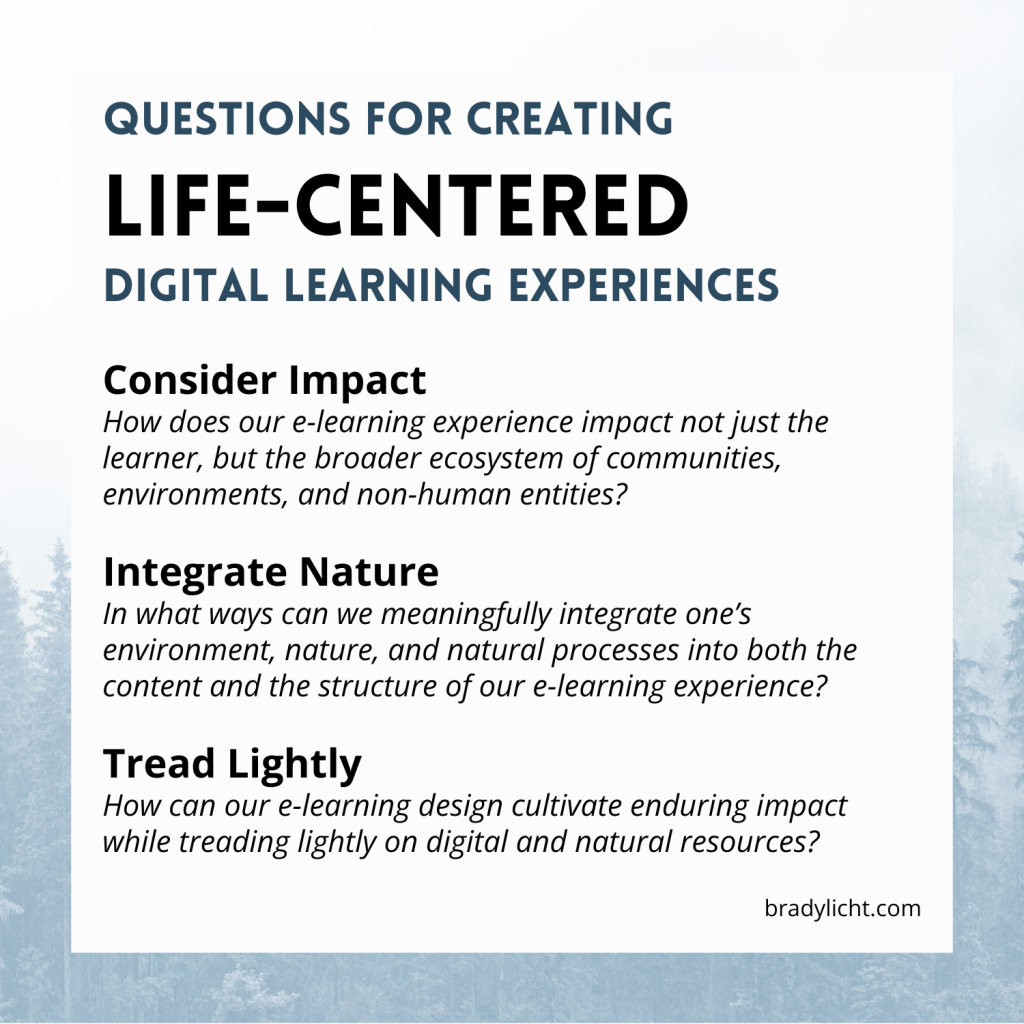
How does our e-learning experience affect not just the learner, but the broader ecosystem of communities, environments, and non-human entities? This is the impact question. It asks us to trace the ripple effects of a design decision, from energy consumption to community engagement, from a local ecosystem to global sustainability.
In what ways can we meaningfully integrate the learner’s environment, nature, and natural processes into both the content and the structure of the experience? This is the integration question. It pushes us to bring the world into the digital space, whether through content, through design metaphors, or by sending learners out into their own surroundings.
How can our design cultivate enduring impact while treading lightly on digital and natural resources? This is the tread-lightly question. It asks for adaptive, long-lived content that supports deep, reflective learning and stays relevant, while keeping the digital footprint small. The garden designer Koichi Kawana said that simplicity is the achievement of maximum effect with minimum means, and I have not found a better summary of what this question is after.
Bringing a non-human persona into the conversation
To make the three questions concrete, try creating a non-human persona and running the questions through it. The process is short:
- Choose a non-human entity relevant to your context: a local ecosystem, a particular species, or the digital platform itself.
- Research its characteristics, needs, and challenges, especially where they intersect with human activity and learning.
- Give it a name and a voice, and write a short narrative for it.
- For each of the three questions, ask how your decisions would land on this persona. How would the experience affect its wellbeing? How could it be integrated into or benefit from the learning? What would sustainable value look like from its perspective?
The point is not to arrive at quick answers. It is to make sure the design conversation includes perspectives that would otherwise never be in the room. As the LCD School reminds us, the planet and society benefit from well-considered, slower-developed pathways rather than hurried, quickly-sold solutions.
If you are working through any of this in your own designs, or if you have found ways to bring nature and community into digital learning that I have not mentioned here, I would like to hear about it. You can reach me at licht.education@gmail.com, and there is more writing on related topics at bradylicht.com.

