
In an era where power-draining artificial intelligence applications are rapidly being integrated into educational technologies and the LXD/ID process, the need for discussion around sustainable and eco-friendly design in e-learning has never been more critical. No matter where you land on the discussion, we must confront the environmental impact of our digital footprint and the potential disconnection between learners and their world.
Jeroen Spoelstra of the Life-Centered Design School emphasizes this need for a shift in our approach:
“Filling our day with efficiency kills creativity & innovation and is terrible for our planet. We need time to procrastinate and slow down the things we are doing.”
Running this with, I challenge us to reconsider the rapid pace at which we develop and deploy e-learning solutions, often at the expense of thoughtful, sustainable design.
Core Ideas of Life-Centered Design
Life-Centered Design (LCD) offers a framework for addressing these challenges. As defined by the LCD School:
“Life-Centered Design is an actionable design approach that gives designers and other creatives the mindset, opportunity and ability to design holistically. It allows designers to include all life forms and advocates for biological ecosystems and non-user communities. LCD moves away from creating value for the end user & shareholders towards adding value for nature, communities and the economy.”
This holistic approach encourages us to consider the broader impact of our e-learning designs, not just on individual learners, but on communities and ecosystems as a whole.
Current Issues in E-Learning
The e-learning industry faces several sustainability challenges:
- Energy consumption of data centers and devices
- Digital waste from outdated hardware and software
- Cognitive overload from information-dense, fast-paced courses
- Disconnection from natural environments and local communities
- Rapid obsolescence of content and platforms
Moreover, the integration of AI tools in e-learning, while offering potential benefits, raises concerns about data privacy, algorithmic bias, and the environmental cost of training large language models.
Applying Life-Centered Design to E-Learning
To address these issues, we can apply LCD principles to e-learning design:
- Slow Down the Design Process: The LCD School advises, “Working slower might feel uncomfortable because you have a deadline or your boss or clients looks over your shoulder. But going slowly now gets you further in the long run.” In e-learning, this could mean more thorough needs analysis and prototyping phases.
- Integrate Nature: “LCD includes a nature point of view, giving species, habitats & ecosystems a voice in the design practice.” For e-learning, this might involve incorporating nature-based metaphors or encouraging learners to interact with their local environment as part of the course.
- Consider Non-Human Personas: The LCD School suggests creating “non-human personas” to understand the needs of non-human actants. In e-learning, we could consider the “persona” of the local ecosystem or even the digital platform itself.
- Embrace a Holistic Approach: “Life-Centered Design Landscape is the context you work in with all its elements.” In e-learning, this means considering not just the learner, but the broader impact of the course on communities and environments.
- Foster Open-Ended Exploration: The LCD School encourages us to “Wander Aimlessly” and be comfortable with the unknown. This could translate to more exploratory, less linear e-learning designs.
Guidelines for Life-Centered E-Learning: Three Essential Questions
Introduction to the Focused Approach
In the spirit of the Life-Centered Design School’s emphasis on slowing down and focusing on what truly matters, I’ve distilled these guidelines into three essential questions for e-learning and training design. These questions encapsulate the core principles of life-centered design, encouraging deeper reflection and more holistic consideration of our learning experiences’ impact.
By limiting ourselves to three questions, we create space for more profound exploration of each aspect, aligning with the LCD School’s advice: “Going slowly now gets you further in the long run.” This focused approach allows learning experience designers to engage in meaningful dialogue with stakeholders, fostering a deeper understanding of life-centered principles and their application to e-learning.
Three Essentials for Life-Centered E-Learning
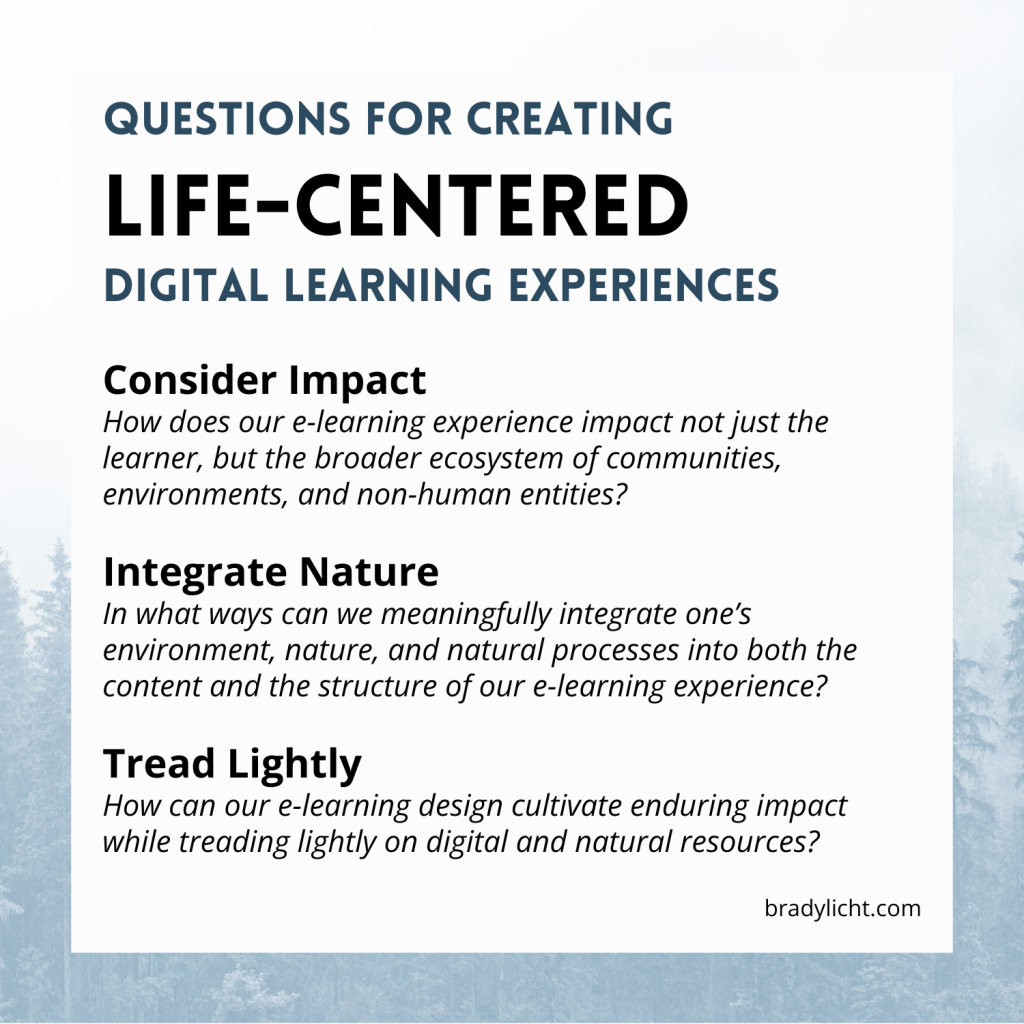
- Consider Impact: How does our e-learning experience impact not just the learner, but the broader ecosystem of communities, environments, and non-human entities? This question encourages us to consider the ripple effects of our design decisions, from energy consumption to community engagement, and from local ecosystems to global sustainability.
- Integrate Nature: In what ways can we meaningfully integrate one’s environment, nature, and natural processes into both the content and the structure of our e-learning experience? This question prompts us to explore how we can bring nature into our digital learning spaces, whether through content, design metaphors, or by encouraging learners to engage with their local environments.
- Tread Lightly: How can our e-learning design cultivate enduring impact while treading lightly on digital and natural resources? This question prompts us to create adaptive, timeless content that fosters deep, reflective learning and maintains relevance, all while minimizing our digital footprint and resource consumption. Key to this is balancing impact with resources: “simplicity means the achievement of maximum effect with minimum means” (Dr. Koichi Kowana, Garden Designer).
Incorporating Non-Human Personas in the Discussion
To further enrich this discussion and truly embrace life-centered design, consider creating and incorporating a non-human persona. Here’s a simplified process:
- Choose a non-human entity relevant to your e-learning context (e.g., a local ecosystem, a specific species, or even the digital platform itself).
- Research its characteristics, needs, and challenges, particularly in relation to human activities and learning.
- Create a narrative for this entity, giving it a name and “voice.”
- For each of the three questions above, consider how your decisions might impact this non-human persona. For example:
- How would our e-learning experience impact [Persona Name]’s wellbeing?
- How could [Persona Name] be integrated into or benefit from our learning experience?
- What would sustainable value mean from [Persona Name]’s perspective?
By including this non-human perspective, you ensure that your e-learning design truly considers all stakeholders, aligning with the holistic principles of life-centered design.
Remember, the goal of this focused framework is not to reach quick answers, but to engage in thoughtful, multi-perspective dialogue that leads to more sustainable and life-centered e-learning solutions. As the LCD School reminds us:
“The planet and society benefit from well-considered, slower-developed holistic pathways instead of hurried, cheap & quickly-sold solutions.”

 Brady Licht
Leave a reply to Beyond Greenwashed Training: Bringing Ecopedagogy Into the Office – Brady Licht Cancel reply