

Professional development (PD) plays a crucial role in keeping educators up-to-date with the latest teaching strategies and technologies. However, when self-paced online learning opportunities for K-12 educators began generating a high number of help tickets, it became clear that a user-centered approach was needed to address the challenges. This case study explores how user research, a component of user experience design (UXD), principles were applied to improve the delivery of online professional development, resulting in a more effective and user-friendly learning experience.
The Challenge
Initial Problem Identification
At a K-12 professional development organization, self-paced online learning opportunities delivered through the Canvas Learning Management System (LMS) were receiving an unusually high number of help tickets. Upon closer examination, we discovered that:
- The majority of tickets were related to user experience issues rather than educational content or value.
- Common complaints included difficulties with navigation and ease of access.
- New users seemed to struggle the most with the platform.
This situation presented a unique opportunity to leverage UXD principles in an educational context, bridging the gap between technology and learning outcomes.
The UXD Approach
While my background in educational technology initially led me to consider a Learning Experience Design (LXD) approach, the nature of the complaints pointed towards a need for a more user-centered solution. This realization prompted me to don my UXD hat, focusing on improving customer satisfaction through an enhanced user interface.
It’s worth noting the distinction between LXD and UXD:
- LXD aims to meet learning targets and create behavior change
- UXD focuses on improving customer satisfaction, often through effective user interfaces
Despite their differences, both disciplines draw on related concepts, allowing me to apply my research methods background from my Master’s coursework to this UXD project.
The Process
Research Plan 1: Onboarding Focus
Initially, we hypothesized that improving the onboarding process would address many of the user complaints. To test this assumption, we:
- Developed a generative toolkit for the course welcome letter, home page, and syllabus.
- Conducted co-design sessions with three former educators as an approximate audience.
Reflection: In retrospect, this narrow focus based on assumptions about onboarding issues could have led us to miss broader insights. A more clearly defined problem statement and research questions would have provided better direction from the start.
Pivoting: A Change in Scope
During the first research phase, new organization-wide data revealed that customers felt their experience could be improved across all aspects of the platform. This prompted:
- Broader discussions about processes and quality assurance
- A request for a more comprehensive research plan
Reflection: The introduction of “quality” as a key concept in these discussions highlighted the need for a clearer definition of what constitutes quality in online professional development. Different user groups may have varying, and sometimes contradictory, perceptions of quality.
Research Plan 2: Quality Focus
To address the expanded scope, we implemented a more robust research strategy:
- Distributed an open questionnaire to all users within the Canvas LMS instance.
- Invited respondents to participate in video conferencing discussions about their experiences.
- Conducted in-depth interviews with four users who volunteered for follow-up conversations.
This approach yielded rich insights into user behaviors, preferences, and pain points.
Key Findings
Defining Quality
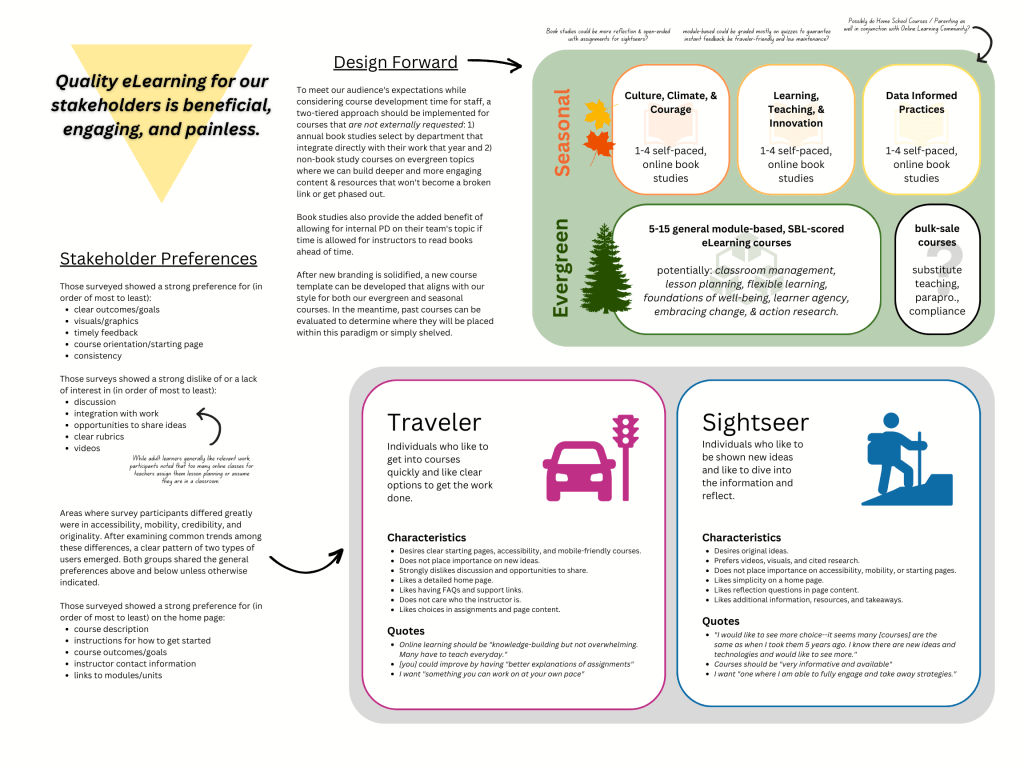
Through our research, we developed a working definition of quality eLearning as being beneficial, engaging, and painless. This definition helped guide our subsequent design decisions.
User Personas
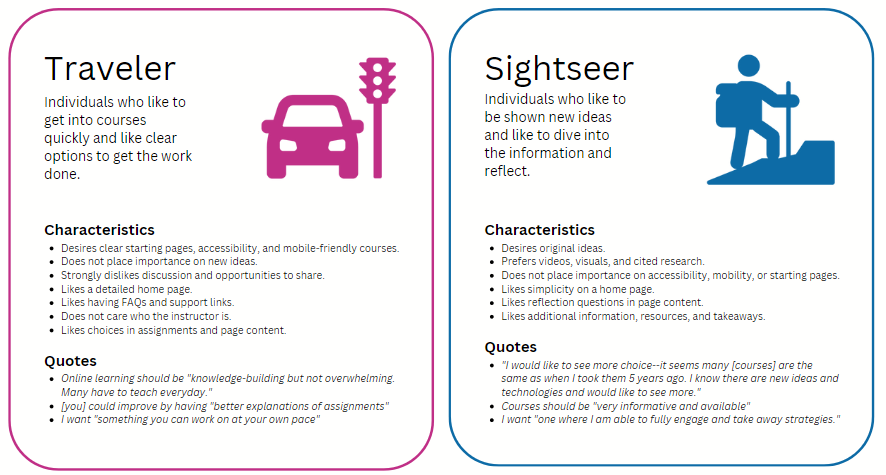
Our analysis revealed two distinct user personas:
- The Traveler
- Desires clear starting pages, accessibility, and mobile-friendly courses
- Prefers detailed home pages with FAQs and support links
- Likes choices in assignments and page content
- Dislikes discussion and opportunities to share
- The Sightseer
- Desires original ideas and prefers videos, visuals, and cited research
- Likes simplicity on home pages and reflection questions in content
- Enjoys additional information, resources, and takeaways
- Less concerned with accessibility and mobile-friendliness
Reflection: While these personas provided valuable insights, we later realized the importance of communicating their limitations to the team to prevent unverified conclusions about users.
General User Preferences
Across both personas, users showed strong preferences for:
- Clear outcomes and goals
- Visuals and graphics
- Timely feedback
- Course orientation and clear starting pages
- Consistency in course design
Conversely, users showed less interest in:
- Discussion forums
- Integration with work
- Opportunities to share ideas
- Clear rubrics
- Videos (though this varied between personas)
Solution Design
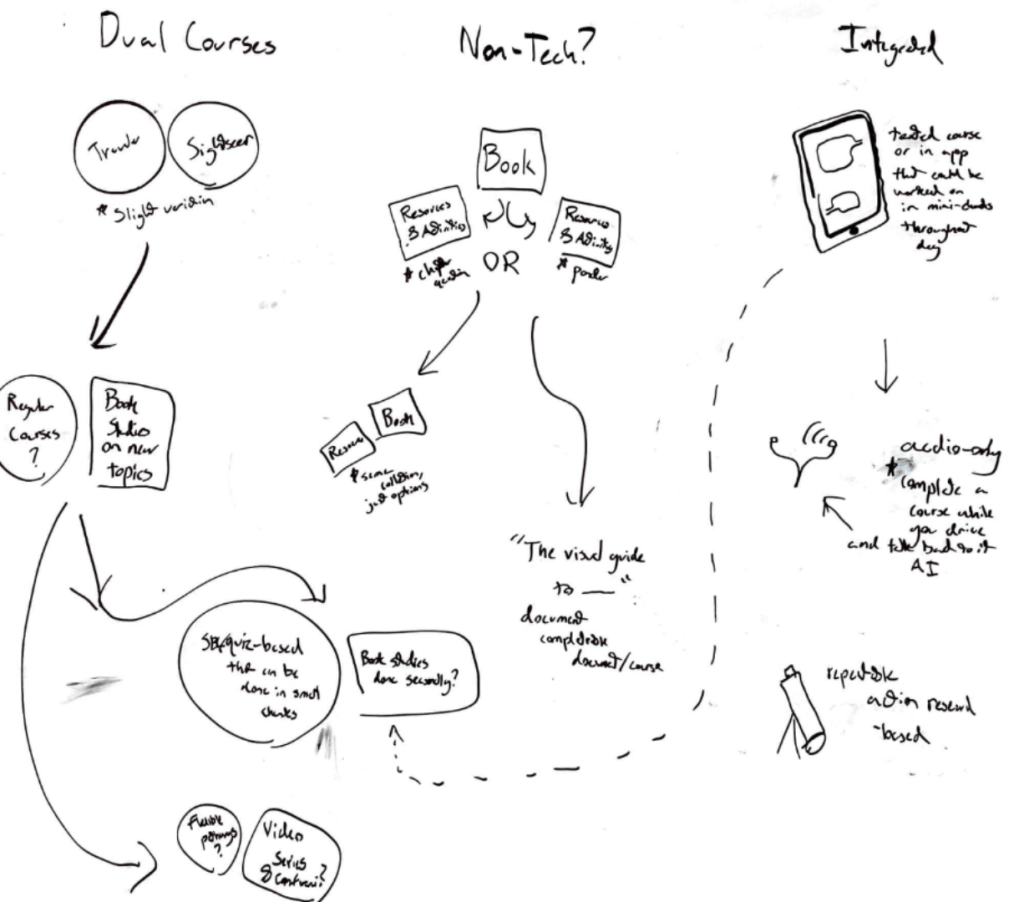
Ideation and Market Considerations
Armed with our research findings, we brainstormed solutions that could meet the needs of both user groups while aligning with our new definition of quality. We considered various factors, including:
- Development time
- Longevity of the solution
- Cost of LMS per user/seat
- Ease of internal adoption
- Larger organizational structure
- Alignment with other initiatives
We also conducted a SWOT analysis and competitive analysis of other online, self-paced professional development offerings to identify market opportunities.
Two-Tiered Solution
After careful consideration, we proposed and received approval for a two-tiered solution:
- “Evergreen” Modular Courses
- Module-based and divisible content
- Mobile-friendly design
- Topics unlikely to change rapidly
- Primarily scored through automated quizzes with rich feedback
- Various content delivery options including custom videos and simulations
- Longer development time but meets the needs of “Travelers”
- “Seasonal” Book Studies
- Contemporary book studies
- Focus on reflection and chapter journals
- Primarily scored on completion of reflection journals
- Optional takeaways and job aids
- Shorter development time and doubles as internal PD
- Meets the needs of “Sightseers”
Reflection: While leadership appreciated the market considerations in this solution, we should have involved the broader team earlier to gauge their reactions and build coalition.
Implementation
Testing and Templating
To prepare for rollout, we:
- Built templates of the book study framework in Figma
- Tested key user flows with educators, focusing on:
- Finding information on credit requirements
- Navigating to the main assignment
- Created a design tool to help team members build within the two-tier solution
- Built as a fillable slide deck for ease of access and sharing
- Supported the spiral model of instructional design
- Tested key elements with a team member
Rollout
The research, ideation process, and solution were presented to the full team through:
- A comprehensive slide deck
- Props representing user groups
- Work time to start on the new process
We emphasized the transition process from old course frameworks to the new model.
Reflection: The team’s reception of the research presentation highlighted the need to better bridge the gap between educational research expectations and UX research methods. In future presentations, I would:
- Begin with a discussion of design biases
- Compare and contrast educational research and user research
- Frame user research as similar to practical action research
- Provide more evidence of the issues presented by support tickets and organizational data
Future Improvements
Moving forward, we plan to:
- Continuously update user personas and our definition of quality through ongoing discovery and research
- Measure the success of the new two-tiered solution against older experiences using exit surveys
- Implement conversation mining to enhance written instructions and content
- Evolve our processes as the fields of “UX of EdTech” and “L/UXD” become more established
- Address previously noted opportunities for improvement through one-on-one conversations with team members
- Develop a common language around UXD within the organization
Conclusion
This case study demonstrates the value of applying UX design principles to educational contexts, particularly in professional development. By focusing on user needs and experiences, we were able to create a more effective, engaging, and user-friendly learning environment for K-12 educators.
The process highlighted the importance of:
- Remaining flexible and open to changing scope based on new information
- Balancing user preferences with educational rigor and organizational constraints
- Communicating research methods and findings effectively to diverse stakeholders
- Continuously iterating and improving based on user feedback and emerging best practices
As the fields of UX in EdTech and Learning/User Experience Design continue to evolve, this project serves as a stepping stone towards more user-centered approaches in educational technology and professional development.
 Brady Licht