

As a learning experience designer and a longtime reader of Ursula K. Le Guin, I keep finding my way back to her essay “The Carrier Bag Theory of Fiction.” Le Guin is best known for novels like The Left Hand of Darkness and The Dispossessed, but this short essay has a lot to say to those of us working where education and technology meet.
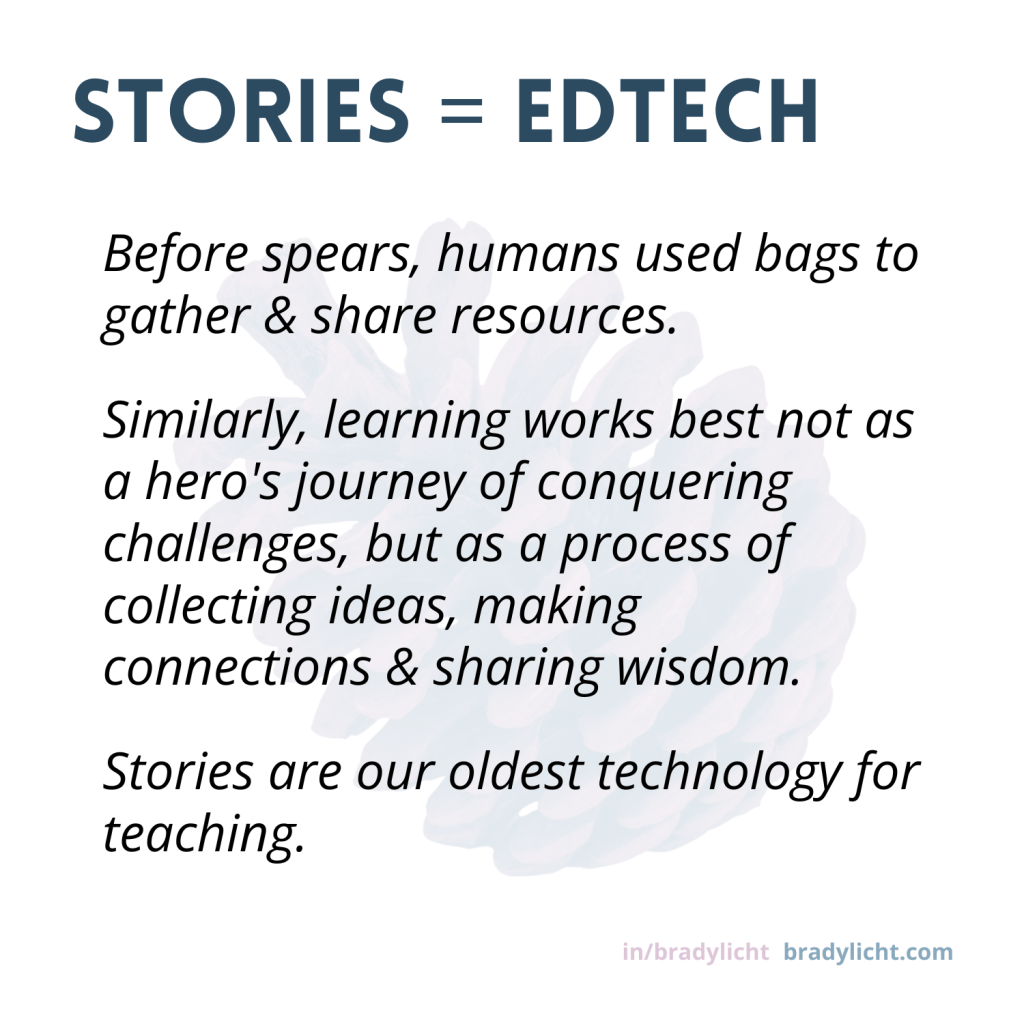
Drawing on the anthropologist Elizabeth Fisher, Le Guin argues that the first human tool probably wasn’t the spear but the container, since before we hunted with weapons we gathered with bags, collecting, keeping, and sharing what we found. Our favorite stories are built like spears, driving through conflict toward a climax, and Le Guin asks what stories would look like if they were built like bags instead, as vessels that gather and hold human experience. She was writing about fiction, so I’m borrowing her idea when I apply it to learning design, but I think the borrowing holds up.
What’s wrong with the hero’s journey?
A lot of learning design follows the hero’s journey: the learner faces challenges, overcomes obstacles, and comes out transformed. It shows up all over educational technology, in gamified platforms that treat knowledge as something to conquer, in learning management systems that lock content into strict sequences, and in achievement systems that celebrate individual wins over shared growth. Having implemented more of these systems than I can count, I’ve grown skeptical of that shape.
In my experience, real learning looks more like gathering than conquering. I’ve watched students learn best when they can collect ideas at their own pace, make connections nobody planned, and add to something the group understands together. Their paths rarely follow a neat arc. They loop back, branch out, pause, and sometimes move sideways rather than forward, and the learning is often more about relationships than achievements.
Stories as Overlooked Technology
When we talk about educational technology, we tend to mean digital tools, and we overlook the oldest and most accessible learning technology we have. Stories work across abilities, need no device, stand on their own while connecting to each other, carry a great deal of knowledge that’s hard to state directly, and are shaped for human memory.
What would a carrier bag learning environment hold?
Instead of building predetermined pathways, we could design learning environments as containers: portfolios that grow over time, knowledge bases a group builds together, collections students curate themselves, and space for community stories and for connections across disciplines. Containers like these are better suited than most e-learning to the kinds of knowledge that resist a module, such as professional intuition, cultural understanding, ethical judgment, community wisdom, decisions that depend on context, and the dynamics of relationships. Stories carry that kind of knowledge well, which is part of why they make good things to put in the bag.
What does this look like in practice?
The tools I’ve seen work best tend to share some carrier bag qualities, even when nobody designed them with Le Guin in mind. They allow flexible navigation, hold many kinds of content, leave room for community knowledge and for learning nobody planned, and give people ways to make connections of their own. They also leave space for the human parts of learning: personal stories, feeling, multiple perspectives, collective memory, and relationships.
Assessment would shift too. Rather than measuring milestones reached, a carrier bag approach looks at what a learner has gathered and done with it, through portfolios, the connections they’ve drawn between ideas, what they’ve contributed to the group, documentation of their process, and what they’ve passed on to others.
Can a bag be built inside a spear?
Le Guin’s science fiction imagined other ways of being human, and we could stand to imagine other ways of learning. Her essay suggests that the future of learning design may lie less in breakthrough technologies than in understanding and supporting how people already gather, share, and make knowledge together.
I’ll admit the carrier bag is easier to describe than to build. Most of the platforms I work in, including the ones I administer, were designed around the spear, with fixed sequences, completion bars, and badges for reaching the end. Stories and shared collections tend to survive in the gaps those systems leave, in a discussion thread nobody grades or a folder a team keeps adding to. I’m not sure yet whether a bag can be built on top of a spear, or whether the best a designer can do is protect the gaps.
If you’ve designed something closer to a bag than a spear, I’d like to hear about it. You can reach me at licht.education@gmail.com, and there are more tools, articles, and resources at bradylicht.com.

