
Educators and parents looking for AI literacy books for kids will find everything from carefully researched materials to hastily produced content, and a fair amount of the latter was written by AI itself. I read through a stack of titles in the summer of 2025, and below are the ones I’d recommend, organized by audience, with notes on how each works for solo reading, family time, group settings, and classrooms. Prices were current as of that summer.
All Audiences: Artificial Intelligence and Me by Ready AI
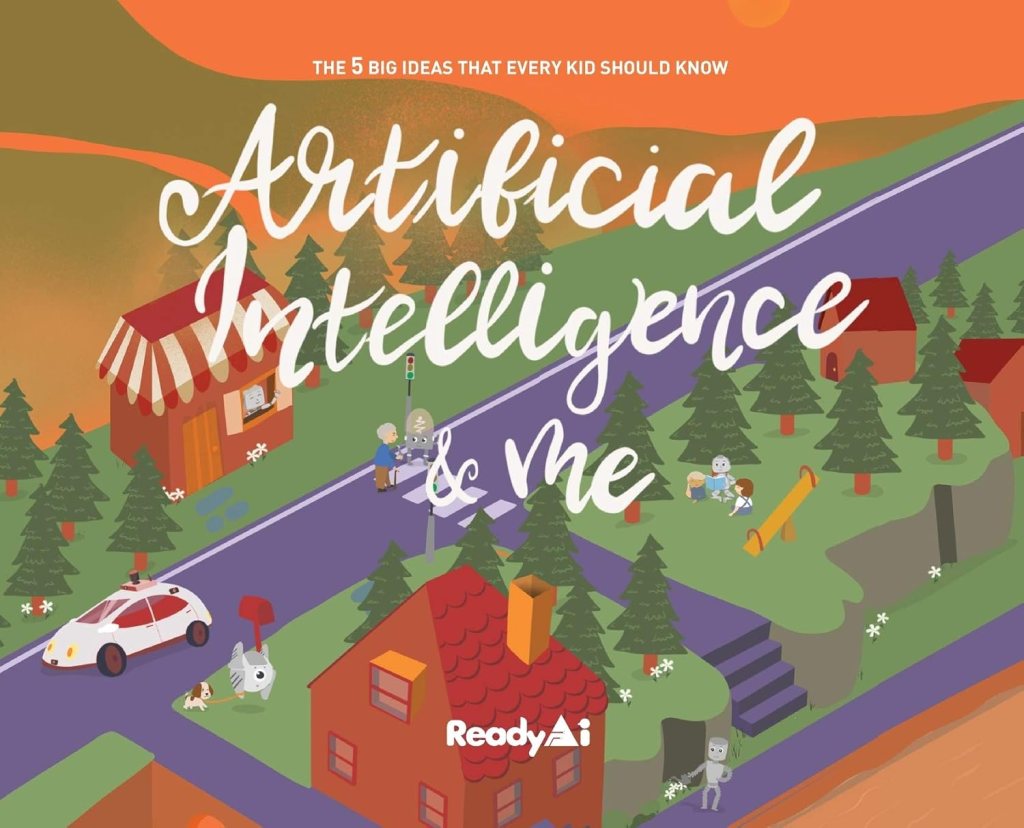
This five-book series was the strongest option I found across age groups. Ready AI built it on published AI literacy frameworks, and each book takes on a different aspect of AI (machine learning, data, applications) with professional illustrations and age-appropriate explanations. What sets it apart is how well it travels: the larger format and clear typography work for a family read-aloud, a scout group, a church youth program, or a classroom. There’s little text per page, which keeps younger children with it, but there’s enough underneath for real discussion with older students. The price is higher than the alternatives. Schools can bring that down by buying the individual books that cover the concepts they need rather than the full series.
Implementation versatility: Works for solo reading at home, family learning time, youth group discussions, or whole-class instruction, and the discussion-friendly format adapts to most group sizes.
Kindergarten and Younger: Artificial Intelligence for Babies by Chris Ferrie
Part of the Baby University series, this board book tries to introduce AI to the youngest learners through simple language and colorful illustrations. It does a decent job of breaking down what the words “artificial” and “intelligence” mean when you put them together, but it doesn’t get much further than that, and children won’t come away knowing what AI actually does in the world around them. The illustrations of people and computers interacting get a bit confusing, and there isn’t much a child can take and talk about afterward. For parents who want to start building vocabulary, or plant the idea that computers “think” in their own way, it’s a gentle introduction. The sturdy format holds up to toddlers exploring on their own, family story time, or an early childhood classroom library, though adults will need to do a fair amount of scaffolding to make the ideas stick.
Other options reviewed:
- Tinker Toddlers: Artificial Intelligence for Kids by Dr. Dhoot | $9 – Alternative: Attempts two-tier learning approach but introduces advanced terminology without adequate context
- Generative AI for Babies by Fynman Xu – Skip: AI-generated content with rhyming structure that provides no educational value
Elementary Students: A Kid’s Book About AI by Neha Shukla
This one balances awareness of AI with critical thinking better than anything else I read for elementary students. Shukla writes in a clear, personal voice, and she walks children through the basics (computer vision, natural language processing) without overwhelming them. More importantly, she spends real time on bias, facial recognition, and misinformation. The minimalist layout won’t work for every reader, since the abstract illustrations are more decorative than explanatory, but the writing itself gives children a solid foundation. The book avoids both uncritical enthusiasm and fear, and asks children to think about how they might use AI responsibly. At around $20 it costs more than some alternatives, and I think the writing is worth it. It works for independent reading, family discussion, scout badge activities, or classroom literature circles.
Other options reviewed:
- Future AI Expert by Future Smart Minds – Skip: Activities lack conceptual depth, focuses on Scratch without teaching underlying concepts
- AI Meets AI by Amber Ivy | $15 – Skip: Focuses on science fiction robots rather than real AI applications, reinforcing misconceptions
Middle School Students: Artificial Intelligence Activity Book by Sam Hutchinson

This activity book pairs each concept with something to do. Every spread puts an AI concept on the left page and a hands-on activity on the right, running from early programs like ELIZA to large language models. The part I value most for middle schoolers is that it’s entirely paper and pencil, so it works the same in a well-equipped computer lab as in a classroom with no devices at all. A few of the activities lean more toward fun than toward illustrating the concept, but the explanations and visuals help students get a handle on machine learning and neural networks without drowning in technical detail. At under $8, buying a class set is realistic for most schools. It works for individual work, partner activities, homeschool, youth group STEM nights, or classroom enrichment, and it fits into computer classes, science, math extensions, or social studies discussions about technology and society.
Other options reviewed:
- AI for Kids: Learn, Create & Master ChatGPT by Sophia Anthony | $15-20 – Alternative: Age-appropriate tone but tool-specific focus may become outdated quickly
- AI and Chat GPT for Kids by Caleb Munroe – Skip: AI-generated content with low-quality design and minimal educational substance
- The Ultimate Guide to Understanding AI for Kids by Kabe Perry – Skip: AI-generated content with formulaic structure and no educational value
- AI Made Simple for Kids by Kabe Perry – Skip: Same author, same problems with AI-generated content
Secondary Students: Machine Learning for Kids by Dale Lane
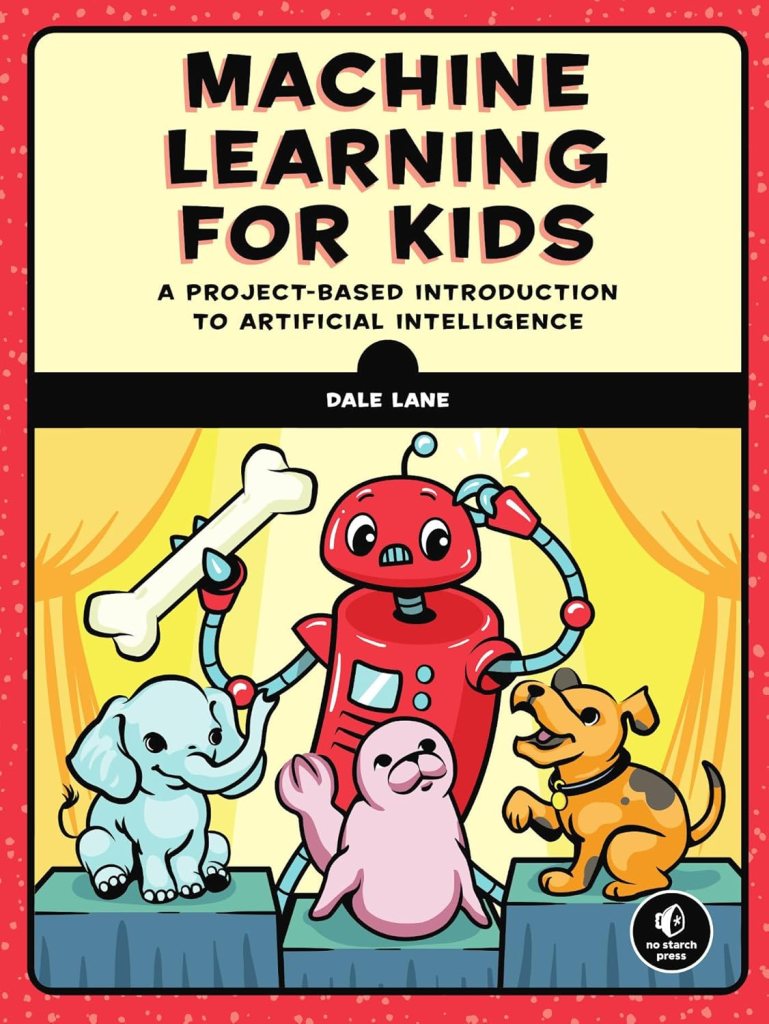
This workbook from No Starch Press is the only one I found that has older students actually build machine learning projects rather than read about them. Using Scratch, students create working systems (recommendation engines, language processors, image classifiers) and learn about training data, models, and bias in the process. The explanations for each project are thorough and well illustrated, and they make hard ideas accessible without talking down to students. Lane treats algorithmic bias and ethics as part of the projects themselves rather than as a chapter at the end. The trade-off is time: this is closer to a semester of curriculum than a supplementary read. For AP Computer Science, advanced STEM programs, independent study, or motivated homeschoolers, though, nothing else on this list goes as deep. It’s also the most expensive book here, which may limit how many schools can use it.
Parents: Intro to AI for Parents by Ready AI

This pocket-sized guide gives parents what they need without piling on technical detail. It opens with a glossary, and for each term it offers both an explanation for the parent and a kid-friendly version, which recognizes that parents need to understand the idea themselves and also find the words to explain it at home. From there it covers AI safety, conversation starters, and family activities that make the concepts tangible. It takes both the possibilities and the concerns seriously without leaning on fear, and the activities are real engagement rather than busy work. The small format means you can actually bring it along to a family activity, scout meeting, or youth program. At around $12-15, it’s within reach for most families and holds up as a reference.
Other options reviewed:
- AI Education for the Next Generation by Ready AI | $25-30 – Alternative: Solid technical foundation but functions more as reference for parents and educators than hands-on curriculum
How do these work in different settings?
Each of these works in more than one context. All of them support independent reading, and the activity books and the Lane workbook work especially well for self-directed students. The discussion-friendly formats suit family learning time, with the parent guide filling in the background adults need. Scout groups, church youth programs, and homeschool co-ops can use them for STEM badges or technology discussions, and teachers can use them for whole-class instruction, reading circles, enrichment, or a full unit, depending on need and budget.
Whichever you pick, match it to the setting you actually have, and favor the books that help kids understand how AI works and where it falls short over the ones that just make them comfortable using it.
If you’ve used any of these with kids, or found one I missed, I’d like to hear about it. You can reach me at licht.education@gmail.com, and there are more tools, articles, and resources at bradylicht.com.

